

Maine Coon Cats: Origin, Size, Appearance and Interesting Facts

Few cat breeds capture the imagination quite like the Maine Coon. Towering over most domestic cats, wrapped in a shaggy coat built for harsh winters, and possessed of a famously gentle disposition, this American original has earned its nickname: the gentle giant of the cat world. It is consistently one of the most popular pedigree breeds in the United States, according to registration data from organizations such as The Cat Fanciers’ Association (CFA).
But the Maine Coon is more than just a big cat. Its story stretches back centuries to the rugged coast of New England, its appearance is packed with adaptations to cold climates, and its personality surprises everyone who expects a large cat to be aloof. This guide covers the breed’s origin, size, appearance, temperament, and the most interesting facts that make the Maine Coon truly one of a kind.
Origin and History of the Maine Coon
The Maine Coon is one of the oldest natural breeds in North America, and its exact origins are wrapped in legend. What historians agree on is that the breed developed in the state of Maine, where longhaired cats — likely brought by seafarers and settlers from Europe — adapted over generations to the region’s brutal winters. Only the hardiest cats survived, and natural selection shaped a rugged, large-framed cat with a heavy, water-resistant coat.
The colorful legends are half the fun. One tale claims Maine Coons descended from the longhaired cats of Marie Antoinette, shipped to America ahead of the French queen’s planned escape. Another insists they are the result of matings between domestic cats and raccoons — a biological impossibility, but the source of both the breed’s name and its famously bushy, ringed tail. A more plausible theory credits Captain Charles Coon, an English seafarer whose longhaired ship cats bred with local felines along the New England coast in the 1800s.
Whatever the truth, the Maine Coon was a celebrated show cat by the late 1800s. A brown tabby Maine Coon named Cosey won Best in Show at the first major American cat show at Madison Square Garden in 1895. The breed’s popularity faded in the early 1900s as exotic imports like Persians and Siamese stole the spotlight, but dedicated breeders in Maine kept the lines alive. By the 1970s the Maine Coon had roared back, and today it is not only a championship breed in every major registry — it is also the official state cat of Maine.
How Big Do Maine Coons Get?
Size is the Maine Coon’s calling card. Males typically weigh between 13 and 18 pounds, with some reaching 20 pounds or more, while females usually range from 8 to 12 pounds. For comparison, the average domestic shorthair weighs around 8 to 10 pounds — so a large male Maine Coon can be roughly twice the size of an ordinary housecat.
Length is equally impressive. From nose to tail tip, Maine Coons commonly measure 30 to 40 inches, and exceptional individuals have stretched past 48 inches. Their height at the shoulder runs 10 to 16 inches, giving them a commanding, rectangular presence that turns heads in any room.
Slow Growth and Development
One of the most distinctive things about Maine Coon size is how slowly it arrives. While most cats reach full physical maturity by about one year of age, Maine Coons keep growing until they are three to five years old. That tiny kitten you bring home will continue filling out — gaining bone, muscle, and coat — long after other breeds have stopped.
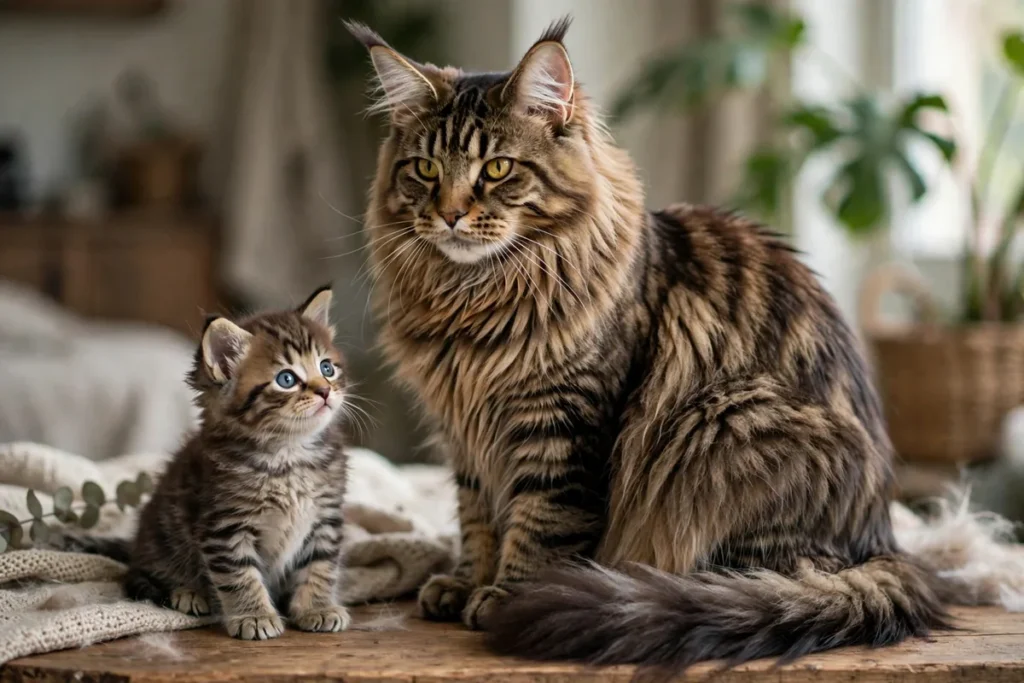
This slow maturation has a charming side effect: Maine Coons retain a kitten-like playfulness well into adulthood. Owners often describe living with a cat that looks like a small bobcat but plays like an oversized kitten for years.
Appearance: Built for Harsh Winters
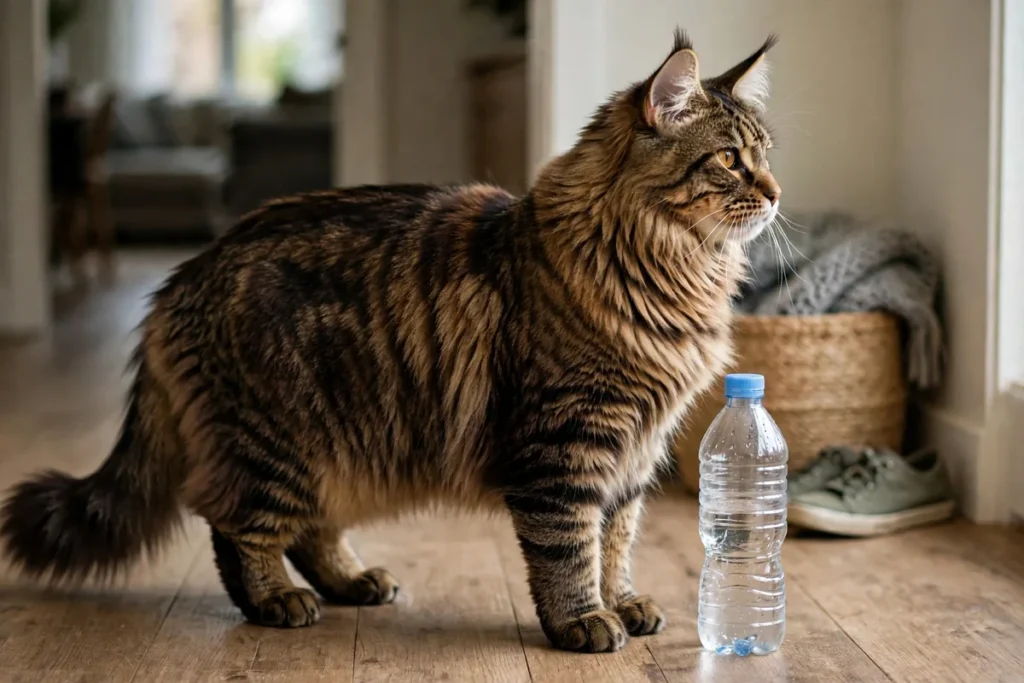
Every feature of the Maine Coon’s appearance tells the story of survival in cold climates. The breed standard, as described by registries such as CFA and The International Cat Association (TICA), calls for a large, muscular, rectangular body — solid and powerful rather than delicate.
The head is medium-wide with high cheekbones, and the muzzle is square and well-defined. Ears are large, set high on the head, and famously tufted — the tufts of fur sprouting from the ear tips, called lynx tips, are one of the breed’s signature features. Eyes are large, slightly oval, and can be green, gold, or copper, though white Maine Coons may have blue or odd-colored eyes.
The tail deserves special mention: long, wide at the base, tapering to a plume that the cat can wrap around its face and body for warmth. Legend says this tail helped wild ancestors survive Maine winters, and watching a Maine Coon curl up with its tail over its nose, you can believe it. Large, tufted paws act like snowshoes, and even the ears and toes carry extra furnishing against the cold.
Coat Colors and Patterns
The Maine Coon’s coat is heavy, shaggy, and water-resistant, with a silky texture that resists matting better than many longhaired coats. It is shorter on the shoulders and longer on the belly and britches — the fluffy “pantaloons” on the hind legs — with a magnificent ruff around the neck that looks like a lion’s mane.
Maine Coons come in a remarkable range of colors and patterns. Brown tabby is the classic and most recognizable, but the breed standard accepts solid colors (black, white, blue, red, cream), tabby patterns (classic, mackerel, spotted, ticked), tortoiseshell, bicolor, smoke, and shaded varieties. The only patterns not accepted in championship competition are pointed (Siamese-style) patterns and chocolate or lavender colors.

Temperament: The Gentle Giant
For all their imposing size, Maine Coons are renowned for sweetness. They are sociable, good-natured cats that tend to get along with children, other cats, and even respectful dogs. Many owners describe them as “dog-like” — they greet family members at the door, follow their people from room to room, and some will even learn to play fetch or walk on a leash.
Maine Coons are not typically lap cats in the clingy sense; they prefer to be near you rather than on you, often settling beside you on the sofa. They are known for their soft, chirping voices — a distinctive trill quite unlike the typical meow — and they use it to “talk” to their families throughout the day.
Their intelligence is another hallmark. Maine Coons are problem-solvers that enjoy puzzle toys and interactive games, and their playful streak lasts far longer than in most breeds. A five-year-old Maine Coon will still chase a feather wand with kitten-like enthusiasm.
Interesting Facts About Maine Coons
- Record holders: Maine Coons have repeatedly held the title of world’s longest domestic cat. One famous record-holder measured over 48 inches from nose to tail tip.
- Polydactyl paws: Extra toes are unusually common in the breed’s history — some Maine Coons are born with six or seven toes per paw, a trait once valued by sailors who believed it made better mousers and climbers.
- Water lovers: Unlike most cats, many Maine Coons are fascinated by water. Owners report cats that dip their paws in water bowls, play with dripping faucets, and follow them into the bathroom.
- A presidential connection: The Maine Coon is the only breed native to the United States with such deep historical roots, and it was designated the official state cat of Maine in 1985.
- The raccoon myth persists: Despite being genetically impossible, the old story that Maine Coons are part raccoon is still the first thing many people ask about — a testament to how wild and striking the breed looks.
- Chirps and trills: The breed’s unusual vocalizations — chirps, trills, and chatters — are so characteristic that experienced owners can often identify a Maine Coon by sound alone.
Living With a Maine Coon: What to Know
A Maine Coon is a big commitment in the most literal sense. These cats eat more than average, need a sturdy scratching post and a large litter box, and their long coat benefits from brushing a few times a week to prevent tangles — though the silky texture makes grooming easier than with many longhaired breeds.
They thrive on companionship and do not enjoy being left alone for very long. A Maine Coon left on its own for extended periods can become lonely, so they suit households where someone is around much of the day or where another friendly pet provides company. In return, owners get one of the most affectionate, entertaining, and loyal companions in the cat world — a true gentle giant.
If you are considering the breed, our Cats & Kittens guides cover everyday cat care, play, and enrichment in more depth. You can also explore our overview of popular cat breeds to compare the Maine Coon with other favorites.
Related Reading on MyPetsMyLove
- Persian Cats: History, Coat Types and Distinctive Features
- Ragdoll Cats: Why This Blue-Eyed Breed Captures So Much Attention
- Best Cat Breeds for First-Time Owners: A Complete Comparison
- Cats & Kittens hub page
- MyPetsMyLove homepage
- About Us page
References
- The Cat Fanciers’ Association (CFA) — Maine Coon breed standard and profile
- The International Cat Association (TICA) — Maine Coon breed information
Frequently Asked Questions
How big do Maine Coon cats get?
Male Maine Coons typically weigh 13 to 18 pounds and females 8 to 12 pounds, with body lengths of 30 to 40 inches from nose to tail tip. They are among the largest domestic cat breeds.
Where did the Maine Coon originate?
The breed developed naturally in the state of Maine, where longhaired cats brought by settlers and seafarers adapted to harsh winters over generations. It is one of the oldest natural breeds in North America.
Are Maine Coons good with children and other pets?
Yes. Maine Coons are known for their gentle, sociable temperament and typically get along well with children, other cats, and respectful dogs. Their patient nature is one of the breed’s most celebrated traits.
How long does it take a Maine Coon to reach full size?
Maine Coons mature slowly, continuing to grow until three to five years of age — much longer than the roughly one year typical for most domestic cats.
Do Maine Coons need a lot of grooming?
Their long, shaggy coat benefits from brushing a few times a week to prevent tangles. The silky texture resists matting better than many longhaired coats, so grooming is manageable with a regular routine.
Why do Maine Coons chirp and trill?
The breed is known for distinctive chirping and trilling vocalizations rather than typical meowing. Owners describe it as the Maine Coon’s way of “talking” to family members, and it is considered a charming breed trait.
Conclusion
The Maine Coon earns every bit of its reputation. A natural American breed shaped by harsh winters, it combines impressive size with a shaggy, weatherproof coat and one of the sweetest temperaments in the cat world. From its legendary origins to its record-breaking length and its famous chirping voice, there is always something new to appreciate about this gentle giant.
If the Maine Coon has captured your imagination, keep exploring: our Cats & Kittens guides dive deeper into breed characteristics, play, and everyday care, and the MyPetsMyLove homepage is the starting point for discovering more remarkable breeds.
Disclaimer
Disclaimer
MyPetsMyLove dot com is an independent informational website covering pet species breeds characteristics activities positive training bonding grooming and responsible ownership
We are not a veterinary clinic medical provider pet food provider or veterinary nutrition service
We do not provide veterinary diagnosis medical advice treatment food recommendations or nutritional guidance
For pet health medical or food related concerns consult a qualified veterinarian or appropriate professional directly
Independent clinics listed on this website are not owned or operated by MyPetsMyLove unless explicitly stated
Verify third party credentials services fees and availability independently
We do not guarantee third party services or outcomes
To the extent permitted by applicable law we disclaim responsibility for independent third party services
Nothing in this notice excludes liability that cannot legally be excluded
The disclaimer does not make prohibited content acceptable
6 Comments