
Abyssinian Cats: Ancient Origins and Their Distinctive Ticked Coat

The Abyssinian cat is one of the oldest-looking breeds in the cat world, and one of the most active. With a short, shimmering ticked coat, large almond-shaped eyes, and long, fine-boned legs, it looks like a small wildcat — and it behaves like one too, always moving, climbing, and investigating. Fans call it the Aby, and it has been a favourite among cat lovers for well over a century.
This guide covers the Abyssinian cat from the beginning — its mysterious origins, its journey to Britain in the 1860s, and its path to recognition around the world. It also looks at the ticked coat that makes the breed unmistakable, its colours, its size and appearance, and its lively, affectionate personality.
Origin and History of the Abyssinian Cat
The documented story of the Abyssinian cat begins in 1868, when a cat named Zula was brought to Britain by Lord Robert Napier, returning from a military expedition to Abyssinia, now Ethiopia. Zula is considered the founding cat of the breed as we know it today, and the breed was developed in Britain from cats like her. The name Abyssinian comes from Abyssinia, the country the cat was thought to come from.
The true origins are less simple than the name suggests. Genetic studies point to the breed’s roots along the coast of the Indian Ocean and in parts of Southeast Asia, rather than Africa, so Abyssinia was most likely the assumed country of import rather than the true origin. The breed’s ancient look also fed a popular legend that it descended from the sacred cats of ancient Egypt, whose paintings and artefacts show cats with a similar lean shape and large ears. That story is part of the breed’s charm, even though the genetics tell a different tale.
Recognition followed step by step. An Abyssinian appeared at the Crystal Palace cat show in London in 1871 and placed third, one of the earliest show appearances for the breed. The Governing Council of the Cat Fancy in Britain, the GCCF, formally recognised the breed in 1929. The Cat Fanciers’ Association in the United States began registering Abyssinians in 1934, and The International Cat Association granted championship status in 1979. The first Abyssinians reached the United States in the early 1900s, were first exhibited in cat shows in 1909, and grew in popularity through the 1930s.
The breed also holds a place in science. In 2007 an Abyssinian cat named Cinnamon became the first cat to have its entire genome sequenced, a landmark moment in feline genetics. American cat lovers have kept the Abyssinian among the Cat Fanciers’ Association’s most popular breeds for decades — in 2022 it ranked 7th among the CFA’s 46 registered breeds. Compared with the most common cat breeds in America, such as the domestic shorthair, the Abyssinian is a pedigreed breed with a much smaller population, yet it has held its place as a favourite for generations.
The Ticked Coat: The Abyssinian’s Trademark
The ticked coat is the first thing most people notice about an Abyssinian, and it is the breed’s most famous feature. Each individual hair is banded with alternating light and dark colours, usually four to six bands, with the darkest shade at the tip. This banding, called the agouti pattern, gives the coat a shimmering, almost iridescent look that changes subtly as the cat moves.
The ticking should be even over the body, with no stripes, spots, or patches. The ridge of the spine, the tail, the backs of the hind legs, and the pads of the paws are always noticeably darker, which adds depth to the coat. The coat itself is short, fine, dense, and close-lying, with a silky feel.
In the breed’s early days in England, Abyssinians were sometimes called “rabbit cats” or “bunny cats” because the ticked coat resembles the agouti colouring of wild rabbits. The nickname faded as the breed became better known, but it shows how striking the coat looked to people seeing it for the first time.

Colours of the Abyssinian Cat
The original and best-known Abyssinian colour is ruddy: a warm, deep reddish-brown base with black ticking. It is the colour most people picture when they think of the breed, and it remains the most common. Cinnamon, also called sorrel or red, is a lighter coppery base with chocolate-brown ticking, and it comes from a unique change in the original pattern.
Blue is the grey version of the same pattern, a warm beige base with darker blue ticking, while fawn is lighter still, a soft creamy peach base. Silver versions pair a pale ground colour with dark ticking. Chocolate and lilac also occur and have full championship status with The International Cat Association, though they are not recognised in the Cat Fanciers’ Association standard.
Eye colour pairs with coat colour. Gold or green eyes are the standard, set in almond-shaped eyes ringed by a fine dark line, which gives the Abyssinian its alert, expressive look. The eyes are one of the breed’s most admired features, and they suit its bright, curious nature.
Appearance: A Lithe, Athletic, Medium-Sized Cat
The Abyssinian is a medium-sized cat with a lithe, fine-boned, muscular body. Adults typically weigh 8 to 12 pounds and stand 8 to 10 inches tall at the shoulder. The body is medium-long and slender, with a well-developed chest, long legs, and a long tail, and the cat often looks as if it is standing on tiptoe.
The head is moderately wedge-shaped, with a slight break at the muzzle and a straight profile. The ears are large, broad at the base, and cupped, set wide apart on the head. The neck is gracefully arched, and the paws are small and oval. Everything about the breed looks built for speed and agility, and it moves with a graceful, almost floating step.
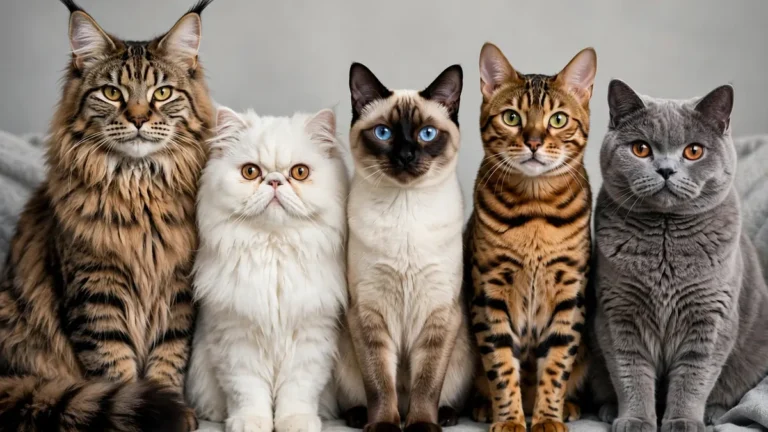
Compared with the tall, heavy Maine Coon, the Abyssinian looks lighter and more delicate, and compared with the stocky British Shorthair, it looks longer and finer-boned. Readers browsing our guide to the most popular cat breeds in the USA will spot the Abyssinian at once by its ticked coat and large ears.
Personality: Active, Curious, and Affectionate
If the Abyssinian looks like a wildcat, its personality is just as memorable. Abyssinians are active, playful, intelligent, curious, affectionate, and social, and they are famously people-oriented. An Abyssinian does not just live in the same house as its owners — it follows them from room to room, supervises whatever they are doing, and asks to be part of it.
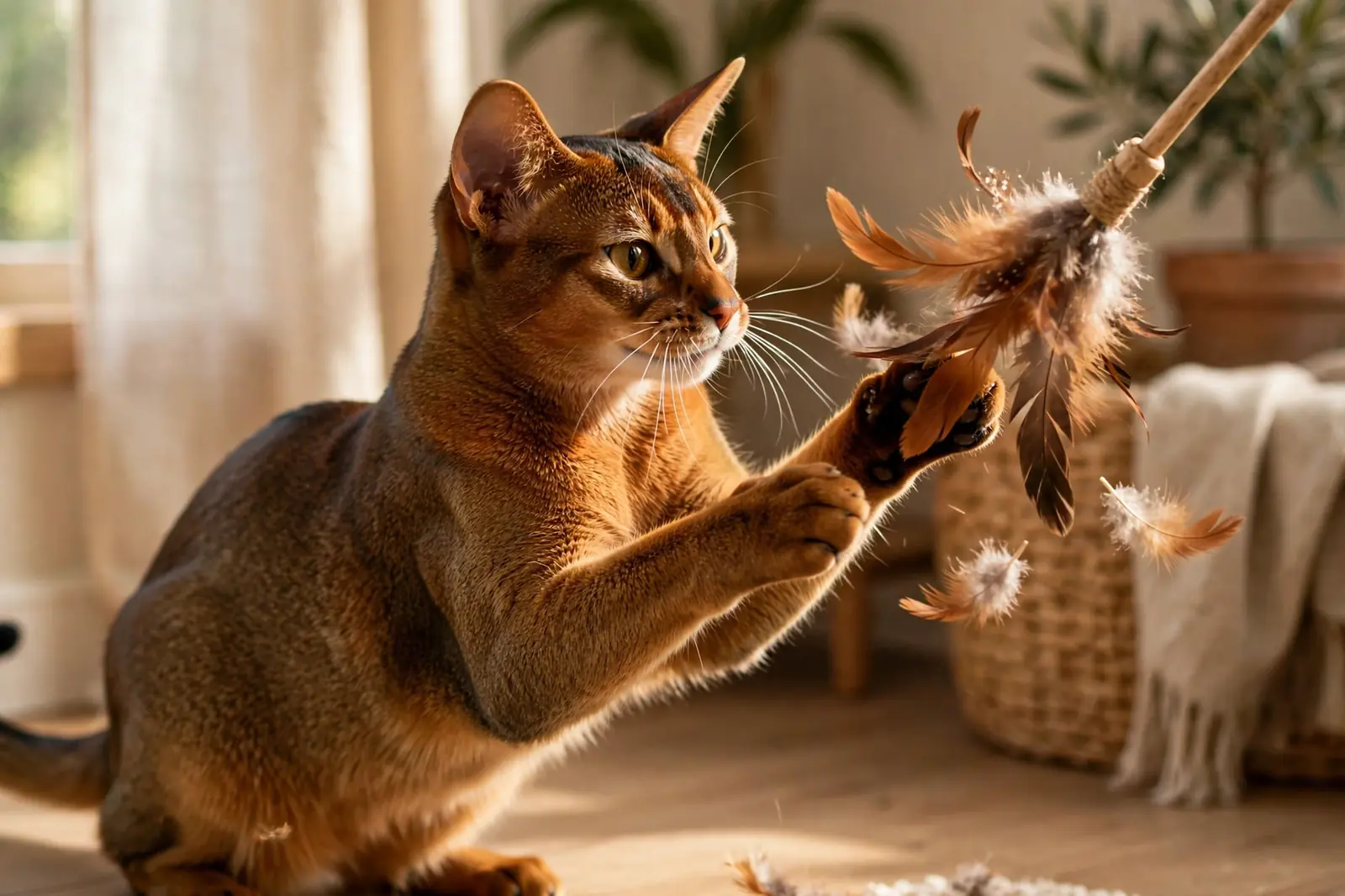
The Cat Fanciers’ Association describes the Abyssinian as one of the most intelligent cat breeds, and that intelligence shows in everyday life. Abyssinians learn routines quickly, work out how to open doors and drawers, and enjoy games that make them think. A feather wand, a rolling ball, or a puzzle toy will hold their interest, and they stay playful well into adulthood.
Climbing is a favourite pastime. These cats are strong climbers by nature and love high places — a tall cat tree, a shelf, or the top of a wardrobe. They are also famously demanding of attention, and an Abyssinian that wants company will let its owner know. Compared with a very talkative breed like the Siamese, the Abyssinian is quieter, and compared with the famously cuddly Ragdoll, it is more independent and far more active.

Abyssinian Kittens: Dark Coats and Boundless Curiosity
Abyssinian kittens are born with dark coats that gradually lighten as they mature, usually over several months. Their ticked pattern develops slowly, so a kitten may look quite different from the adult it will become. Their round faces, large ears, and almond eyes give them an endearing look from the start.
Kittens are curious and playful from an early age. They explore the house, chase toys, climb anything they can reach, and investigate every new sound. They bond readily with the people around them, and a kitten that grows up with gentle handling, regular play, and company becomes a confident, social adult. Because the breed is so active, kittens do best in a home with room to climb and play — see our guide to the best cat breeds for first-time owners for comparisons.

Grooming and Everyday Care
Grooming an Abyssinian cat is simple and ordinary. The short, fine coat sheds lightly, and the Cat Fanciers’ Association notes that a comb or brush a few times a month is enough to keep it looking neat. Baths are generally not needed, and the routine is quick — a few minutes is usually enough.
Beyond the coat, everyday care is straightforward. The ears can be checked and gently wiped as part of the regular grooming routine, and the claws can be trimmed as part of ordinary care. The Abyssinian does best living inside, where it is safe and comfortable, and its active nature means it needs daily play and things to climb. A tall cat tree, a window perch, and a few interactive toys will keep an Abyssinian happy.
Abyssinian vs Other Popular Breeds: A Quick Comparison
Here is how the Abyssinian compares with other reader favourites among the popular breeds:
| Trait | Abyssinian | Siamese | Bengal | Russian Blue |
|---|---|---|---|---|
| Coat | Short, ticked, silky | Short, pointed | Short, spotted or marbled | Dense double coat, silver-blue |
| Colours | Ruddy, cinnamon, blue, fawn | Pointed colours | Spotted and marbled patterns | Silver-blue |
| Build | Medium, lithe, fine-boned | Medium, slender, elegant | Medium to large, athletic | Medium, lithe, fine-boned |
| Eye colour | Gold or green | Blue | Green or gold | Vivid green |
| Energy | High | High | High | Moderate |
| Personality | Active, curious, affectionate | Talkative, social, demanding | Active, playful, curious | Quiet, devoted |
| Best for | Owners wanting an active, clever companion | Owners wanting a chatty, social cat | Active homes, playful cats | Calm homes, devoted companionship |
The Siamese shares the Abyssinian’s energy and love of company, but it is far more vocal. The Bengal matches the Abyssinian’s wild look and high energy, while the Russian Blue is quieter and more reserved. The Abyssinian sits in the middle: active and clever, affectionate without being demanding all day, and always ready to play.
Interesting Facts About Abyssinian Cats
- Zula, the founding cat: A cat named Zula was brought to Britain in 1868 by Lord Robert Napier after a military expedition to Abyssinia, now Ethiopia.
- A show cat since 1871: An Abyssinian appeared at the Crystal Palace cat show in London in 1871 and placed third.
- Recognised in 1929: The Governing Council of the Cat Fancy formally recognised the breed in 1929, and The International Cat Association granted championship status in 1979.
- A scientific first: In 2007 an Abyssinian named Cinnamon became the first cat to have its entire genome sequenced.
- The rabbit cat: Early Abyssinians were sometimes called “rabbit cats” or “bunny cats” because their ticked coat resembles the agouti colouring of wild rabbits.
- A popular breed: In 2022 the Abyssinian ranked 7th among the Cat Fanciers’ Association’s 46 registered breeds.
- Born dark: Abyssinian kittens are born with dark coats that gradually lighten as they mature, usually over several months.
Living With an Abyssinian: What to Know
The Abyssinian cat is a cat for people who want an active, clever companion. It will follow you from room to room, climb to the highest perch in the house, play with a toy when you offer one, and settle beside you in the evening. It does not ask for constant cuddles — it asks for company, play, and things to explore.

Compare the Abyssinian with the main cat breeds in our guide to the most popular cat breeds in the USA, see how it suits new owners in our guide to the best cat breeds for first-time owners, and browse the Cats & Kittens section to keep exploring.
Related Reading on MyPetsMyLove
- Most popular cat breeds in the USA
- Siamese cats guide
- Bengal cats guide
- Cats & Kittens hub page
- MyPetsMyLove homepage
- About Us page
References
- The Cat Fanciers’ Association (CFA) — Abyssinian breed standard and profile
- The International Cat Association (TICA) — Abyssinian breed information and standard
- Encyclopaedia Britannica — cat breeds and history reference
Frequently Asked Questions
Where did the Abyssinian cat come from?
The Abyssinian’s documented story begins in 1868, when a cat named Zula was brought to Britain from Abyssinia, now Ethiopia. Genetic studies suggest the breed’s roots lie along the coast of the Indian Ocean and in parts of Southeast Asia, and the breed was developed in Britain.
What is a ticked coat?
A ticked coat means each individual hair is banded with alternating light and dark colours, usually four to six bands, with the darkest shade at the tip. This agouti pattern gives the Abyssinian coat its shimmering look, with no stripes, spots, or patches on the body.
What colours do Abyssinian cats come in?
The best-known colour is ruddy, a warm reddish-brown base with black ticking. Cinnamon (also called sorrel or red), blue, and fawn also occur, and silver versions pair a pale ground colour with dark ticking. Chocolate and lilac are recognised by The International Cat Association but not by the Cat Fanciers’ Association.
How large do Abyssinian cats grow?
Abyssinians are medium-sized cats. Adults typically weigh 8 to 12 pounds and stand 8 to 10 inches tall at the shoulder, with a lithe, fine-boned, muscular build.
Are Abyssinian cats good with children?
Yes, Abyssinians are known for being good with children. They are active, playful, and social, and they enjoy games and company. See our guide to the best cat breeds for first-time owners for comparisons.
What is an Abyssinian kitten like?
Abyssinian kittens are born with dark coats that gradually lighten as they mature. They are curious, playful, and quick to bond with the people around them, and they love to climb from an early age.
How do you groom an Abyssinian cat?
Grooming is simple and ordinary. The short, fine coat needs only a comb or brush a few times a month, and baths are generally not needed. The ears can be checked and gently wiped as part of the regular grooming routine.
Conclusion
The Abyssinian cat began its documented story with Zula in 1868, appeared at the Crystal Palace show in 1871, and grew into a recognised breed — GCCF in 1929 and TICA championship in 1979 — and even became the first cat to have its genome sequenced in 2007. With a short, shimmering ticked coat in warm ruddy, cinnamon, blue, and fawn, a lithe athletic build, and an active, curious, affectionate nature, it is a cat that brings energy and company into any home.
If you want a clever, playful companion that follows you from room to room and climbs to the highest perch in the house, the Abyssinian is hard to beat. Compare it with other remarkable breeds in our most popular cat breeds in the USA guide, explore the Cats & Kittens section, and start from the MyPetsMyLove homepage to meet more breeds worth knowing.
Disclaimer
Disclaimer
MyPetsMyLove dot com is an independent informational website covering pet species breeds characteristics activities positive training bonding grooming and responsible ownership
We are not a veterinary clinic medical provider pet food provider or veterinary nutrition service
We do not provide veterinary diagnosis medical advice treatment food recommendations or nutritional guidance
For pet health medical or food related concerns consult a qualified veterinarian or appropriate professional directly
Independent clinics listed on this website are not owned or operated by MyPetsMyLove unless explicitly stated
Verify third party credentials services fees and availability independently
We do not guarantee third party services or outcomes
To the extent permitted by applicable law we disclaim responsibility for independent third party services
Nothing in this notice excludes liability that cannot legally be excluded
The disclaimer does not make prohibited content acceptable

2 Comments