Oriental Shorthair Cats: The Big-Eared Breed with a Hundred Colors

Picture a cat with ears so large they look borrowed from a much bigger animal, eyes the color of fresh spring leaves, and a body as sleek as a ballet dancer. Now imagine that cat walking straight up to you, looking you in the eye, and starting a conversation. That is the Oriental Shorthair cat: a close relative of the Siamese with the same elegant build and the same gift of the gab, but dressed in almost any color you can imagine. This guide covers where the breed came from, what it looks like, why its coat comes in hundreds of colors, and what it is really like to share a home with one of the most talkative and devoted cats in the world.
The Siamese Cousin in a Hundred Colors
The Oriental Shorthair began in England in the 1950s, when British breeders set out to create Siamese-type cats in colors beyond the traditional pointed pattern. The Siamese had long been admired for its slender body, wedge-shaped head, and lively personality, but the pointed coat — a darker face, ears, legs, and tail on a pale body — was only one look. Breeders crossed Siamese cats with domestic shorthairs, Russian Blues, British Shorthairs, and Abyssinians, hoping the kittens would keep the Siamese shape and spirit while wearing solid colors and new patterns.
The experiment worked. The kittens were unmistakably Siamese in type: long, lithe, and elegant, with the same wedge head and the same chatty nature. But their coats came in ebony, chestnut, lavender, white, and tabby patterns — colors the Siamese standard did not allow. At first, these colorful cats were treated as Siamese that did not fit the standard, and breeders worked patiently to fix the new colors while keeping the Siamese build.
American breeders took up the same idea in the early 1970s, importing cats from British catteries and adding their own crosses, including the American Shorthair and the Abyssinian, to widen the range of colors still further. The Cat Fanciers’ Association accepted the Oriental Shorthair for registration in 1972 and granted the breed full championship status in 1977. Today the breed is recognized by major registries on both sides of the Atlantic, including the Cat Fanciers’ Association and The International Cat Association.
Appearance of the Oriental Shorthair
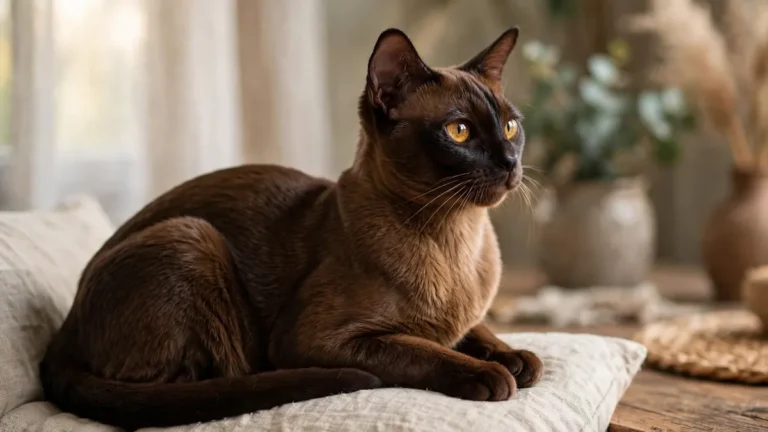
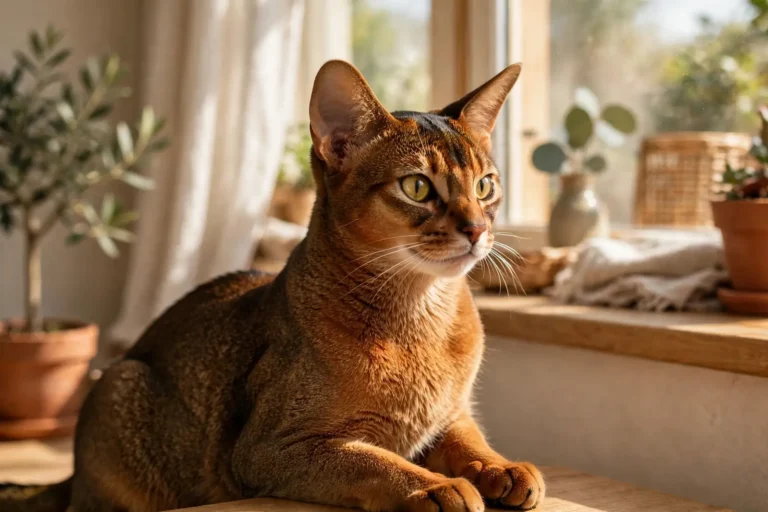
The first thing anyone notices about an Oriental Shorthair is the ears. They are very large, wide at the base, pointed at the tips, and set wide apart so they continue the lines of the wedge-shaped head. The head itself is a long, straight wedge, tapering from the ears to a fine muzzle, with a straight profile and no break at the nose. Together, the head and ears give the breed a look that is unmistakable — elegant, alert, and a little bit dramatic.
The eyes are the second feature that stops people in their tracks. They are almond-shaped, slanted toward the nose, and set wide apart. In most Orientals the eye color is a vivid green, a shade that looks especially striking against a dark coat. White Orientals may have blue eyes or one blue and one green eye, a variation the breed standard allows.
Below that striking head sits a body built for grace. The Oriental Shorthair is a medium-sized cat with a long, slender, tubular body, fine bones, and long, slim legs. It is muscular under the sleek coat, not fragile, and it moves with a smooth, flowing gait. The tail is long and tapering, and the paws are small and oval. Among the main cat breeds kept in American homes, few look quite as refined as this one.
Compared with its closest relative, the Siamese cat, the Oriental Shorthair is almost identical in build — the same wedge, the same ears, the same slender frame. The difference is the coat: where the Siamese wears points, the Oriental wears color all over. Compared with the fluffy Ragdoll cat, it is a study in opposites: sleek where the Ragdoll is plush, and restless where the Ragdoll is relaxed.

Coat Colors and Patterns
If the Siamese is a cat in one outfit, the Oriental Shorthair is a cat with a whole wardrobe. The breed is recognized in hundreds of colors and patterns, more than almost any other breed. Solid colors include ebony, blue, chestnut, cinnamon, lavender, fawn, red, and cream, along with pure white. Then come the patterns: classic and mackerel tabby, spotted tabby, ticked tabby, smoke, shaded, and tortoiseshell, plus bicolor combinations in which white joins any of those colors. A single litter can hold kittens that look like entirely different breeds.
The coat itself is short, fine, and close-lying, with a soft sheen that catches the light when the cat moves. It feels smooth and satiny to the touch, and because it is short with little undercoat, it asks very little of its owner. A gentle brush once a week is usually enough to lift loose hair and keep the coat gleaming, and most Orientals enjoy the attention as part of the routine.
Color develops early and stays true, unlike the pointed coats of the Siamese, which deepen with age. An ebony Oriental kitten is ebony from the start, and a tabby kitten shows its pattern from the first weeks, so what you see in a kitten is very close to what you will get as an adult.

Temperament and Personality
If the Oriental Shorthair looks like a Siamese, it sounds like one too. This is one of the most talkative of all domestic cat breeds, and owners quickly learn that their cat has opinions about everything: the empty food bowl, the closed door, and the bird outside the window. The voice is loud, clear, and expressive, with a range of meows, chirps, and trills.
Behind the voice is a deeply people-oriented nature. Oriental Shorthairs bond hard with their families and like to be involved in everything. They follow their owners from room to room, supervise household chores from a convenient perch, and settle on laps the moment one becomes available.
The breed is also famously intelligent and playful. Orientals learn routines quickly, figure out how to open doors and drawers, and enjoy puzzle toys and games that make them think. A daily play session with a wand toy or a rolling ball is a highlight, and many Orientals will fetch a toy and bring it back for another round.
Orientals usually get along well with children who treat them gently, with other cats, and with friendly dogs, especially when introductions are made slowly. They do best in homes where someone is around for much of the day, because a bored Oriental is a loud Oriental. For readers comparing popular breeds, our guide to the most popular cat breeds in the USA shows where the Oriental sits among the most common cat breeds in American homes.
Oriental Shorthair Kittens
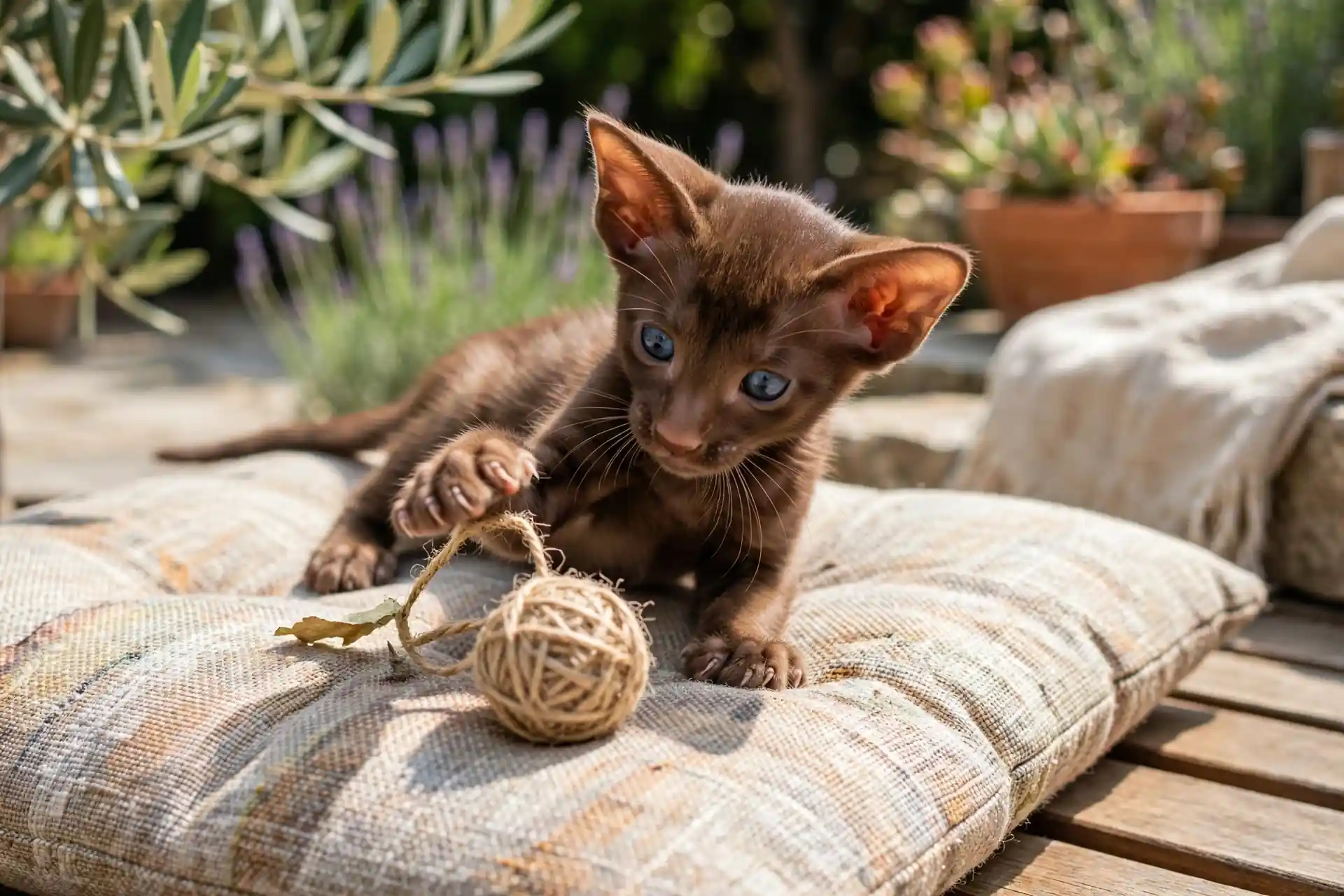
Oriental Shorthair kittens are born looking like tiny versions of the adults they will become — slender, big-eared, and already curious about everything. The ears look almost too large for the kitten at first, and the kitten grows into them over the first months, which gives young Orientals a wonderfully comic appearance. Their eyes start out a soft blue-gray and deepen into the breed’s green as they mature.
Young Orientals are bundles of energy. They climb, chase, pounce, and investigate every corner of the home, and they learn fast. Gentle handling, short play sessions, and introductions to everyday household sounds help a kitten grow into the confident, social adult the breed is known for.
Bringing a new kitten home is a big change for a small cat, and a calm first week makes all the difference. Our guide on how to help a cat adjust to a new home covers the steps that help a new arrival settle in happily. Anyone choosing between the elegant pointed breeds may also enjoy our Abyssinian cats guide, another slender, short-coated breed with a lively and curious nature.
Living With an Oriental Shorthair
Life with an Oriental Shorthair is never quiet and never dull. This is an indoor companion that wants to be where its people are, whether that means riding on a shoulder while you cook or curling up under the covers at night. A sunny window perch and a tall scratching post will cover most of what an Oriental asks from its home.
The breed is athletic and loves height. A sturdy cat tree with a high perch is well used, and many Orientals enjoy leaping to the top of bookcases and wardrobes. Short play sessions spread through the day suit the breed better than one long session, and puzzle feeders and interactive toys keep a clever mind busy. For more ideas, our guide to interactive cat toys covers the types of play that hold an Oriental’s attention longest.
Because Orientals are so social, they are happiest in homes where they are not left alone for long stretches. Many owners find that two cats keep each other company beautifully, and an Oriental often welcomes a feline companion, especially another lively breed. What the breed gives back is devotion in full measure: a cat that greets you at the door, talks to you about its day, and chooses your lap above every other seat in the house.

Oriental Shorthair vs Siamese
| Breed | Coat | Eyes | Ears | Temperament |
|---|---|---|---|---|
| Oriental Shorthair | Short, sleek, hundreds of colors | Green, almond-shaped | Very large, wide-set | Vocal, lively, deeply people-oriented |
| Siamese | Short, fine, pointed | Blue, almond-shaped | Large, wide-set | Vocal, lively, demanding |
| Birman | Semi-long, silky, pointed | Deep blue | Medium | Gentle, calm, people-oriented |
| Ragdoll | Semi-long, plush, often pointed | Blue | Medium | Relaxed, affectionate, large |
| Abyssinian | Short, ticked | Green or gold | Large, upright | Curious, active, independent streak |
The table shows how close the Oriental Shorthair and the Siamese really are: the same wedge head, the same slender body, the same voice, and the same devotion to their people. The difference is almost entirely the coat — points on the Siamese, and color everywhere on the Oriental. Against the Birman and the Ragdoll, the Oriental is the sleek, restless, talkative member of the family, while against the Abyssinian it is the more vocal and more people-focused of two lively short-coated breeds.
Interesting Facts About Oriental Shorthairs
- Hundreds of colors: The Oriental Shorthair is recognized in more colors and patterns than almost any other breed, from solid ebony to spotted tabby and bicolor.
- The Siamese in color: Breeders describe the Oriental as the Siamese with the color turned up — the same build, the same wedge head, the same voice, in a rainbow of coats.
- Ears with a purpose: The huge ears are not just for show; they continue the lines of the wedge-shaped head and give the breed its unmistakable profile.
- Green-eyed beauty: Most Orientals have vivid green eyes, while white Orientals may have blue eyes or one of each color.
- A 1970s debut: The Cat Fanciers’ Association accepted the breed for registration in 1972 and granted full championship status in 1977.
- Born chatty: Oriental kittens start talking early, and the habit only grows — this is one of the most vocal breeds in the cat world.
- A loyal shadow: Owners often say their Oriental follows them everywhere, earning the breed a reputation as a devoted companion rather than an aloof cat.

Related Reading on MyPetsMyLove
- Most popular cat breeds in the USA
- Siamese cats guide
- Ragdoll cats guide
- Cats & Kittens hub page
- MyPetsMyLove homepage
- About Us page
References
- Cat Fanciers’ Association (CFA) — Oriental Shorthair breed profile
- The International Cat Association (TICA) — Oriental Shorthair breed profile
- The Humane Society of the United States — pet care and enrichment resources
- Encyclopaedia Britannica — cat breeds reference
Frequently Asked Questions
Why is the Oriental Shorthair called the Siamese in color?
Because the breed shares the Siamese body, wedge-shaped head, large ears, and chatty personality, but wears solid colors and patterns all over its coat instead of the Siamese pointed pattern. Breeders developed it by crossing Siamese cats with other breeds to add color while keeping the Siamese type.
What color eyes do Oriental Shorthair cats have?
Most Oriental Shorthairs have vivid green, almond-shaped eyes. White Orientals may have blue eyes or one blue eye and one green eye, which the breed standard allows.
Are Oriental Shorthair cats vocal?
Yes, very much so. The Oriental Shorthair is one of the most talkative breeds, with a loud, expressive voice and a wide range of meows, chirps, and trills. Owners should expect a cat that comments on daily life and answers back when spoken to.
How many colors do Oriental Shorthair cats come in?
Hundreds. The breed is recognized in more colors and patterns than almost any other breed, including solid ebony, blue, chestnut, lavender, white, and red, plus tabby, smoke, shaded, tortoiseshell, and bicolor patterns.
Are Oriental Shorthair cats good with children and other pets?
Yes, Orientals usually get along well with gentle children, other cats, and friendly dogs, especially when introductions are made slowly. Their playful, social nature suits a busy family home where someone is around for much of the day.
How much grooming does an Oriental Shorthair need?
Very little. The short, fine coat has little undercoat, so a gentle brush once a week is usually enough to lift loose hair and keep the coat gleaming. Most Orientals enjoy the brushing as part of the routine.
Do Oriental Shorthair cats like to be alone?
No, they do not. Orientals bond strongly with their people and prefer company for much of the day. They follow their owners around the home and are happiest in households where someone is around, or where another cat keeps them company.
Conclusion
The Oriental Shorthair cat is the Siamese with the color turned up: huge ears, green almond eyes, a sleek coat in hundreds of colors, and a voice that never runs out of things to say. It is a cat for people who want a companion, not an ornament — one that greets you at the door, supervises your day, and chooses your lap above every other seat in the house.
Compare the Oriental with its closest relative in our Siamese cats guide, explore more breeds in the Cats & Kittens section, and start from the MyPetsMyLove homepage to meet more cats worth knowing.
Disclaimer
Disclaimer
MyPetsMyLove dot com is an independent informational website covering pet species breeds characteristics activities positive training bonding grooming and responsible ownership
We are not a veterinary clinic medical provider pet food provider or veterinary nutrition service
We do not provide veterinary diagnosis medical advice treatment food recommendations or nutritional guidance
For pet health medical or food related concerns consult a qualified veterinarian or appropriate professional directly
Independent clinics listed on this website are not owned or operated by MyPetsMyLove unless explicitly stated
Verify third party credentials services fees and availability independently
We do not guarantee third party services or outcomes
To the extent permitted by applicable law we disclaim responsibility for independent third party services
Nothing in this notice excludes liability that cannot legally be excluded
The disclaimer does not make prohibited content acceptable