
Norwegian Forest Cats: Discover the Story Behind This Beautiful Breed

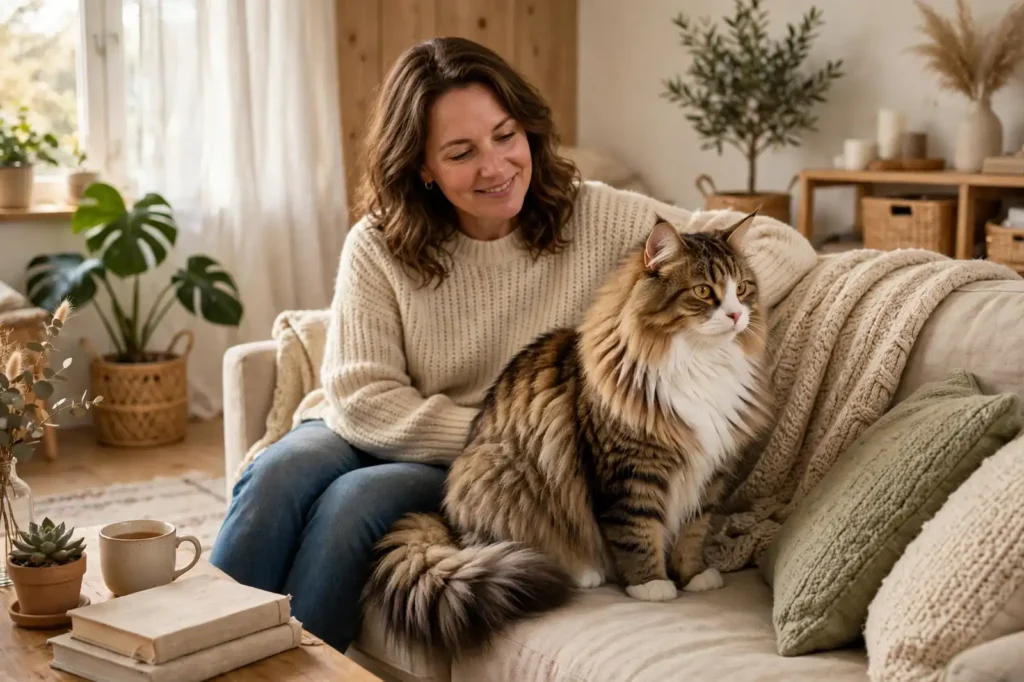
The Norwegian Forest cat is a large, longhaired cat with a thick double coat, a full ruff around its neck, and a long, plumed tail. In its home country it is called the skogkatt, which means “forest cat,” and among fans it is often known by the nickname “Wegie.” It is a natural breed, shaped by the cold forests and farms of Norway rather than by careful crossbreeding, and its story reaches back a thousand years.
This guide covers the Norwegian Forest cat from the beginning — its life as a working farm cat, its near disappearance, its rescue by Norwegian breeders, and its path to recognition around the world. It also looks at its many colours, including the amber coat found in no other breed, its size and appearance, and its calm, friendly personality.
Origin and History of the Norwegian Forest Cat
The Norwegian Forest cat is one of the oldest natural cat breeds in the world. Cats arrived in Norway with the Vikings around the year 1000, and the cats that lived and worked in Norway’s forests and on its farms became the breed we know today. Over centuries of cold winters, the cats that survived were the strong ones with thick, water-repellent coats, and that shaped a large, hardy, longhaired cat.
Norse legends describe large, long-haired cats that were skilled climbers, matching the Norwegian Forest cat of today. The exact history is uncertain — early stories were passed down by word of mouth — but the breed’s roots in farm and forest life are clear. These were working cats that kept rodents in check around farms and barns, living outdoors through harsh winters.
The breed nearly disappeared in the middle of the twentieth century. As more shorthaired cats arrived in Norway, crossbreeding threatened the Norwegian Forest cat’s distinct type, and by the 1940s the breed was at risk of being lost. A group of dedicated Norwegian breeders began a preservation effort, and in the mid-1970s the first breed club was founded in Norway. Its members started a breeding program with carefully selected cats, and those cats were approved for registration by a panel of judges.
Recognition followed step by step. The Norwegian club approved the breed as a domestic breed in 1972, and the Fédération Internationale Féline, known as FIFe, recognized it in 1977. The first breeding pair went to the United States in 1979, and the breed earned championship status with The International Cat Association in 1984. The Cat Fanciers’ Association, known as the CFA, granted championship status in 1993. Today the Norwegian Forest cat is widely described as Norway’s national cat, and it is popular across Europe and North America.
Colours and Patterns of the Norwegian Forest Cat
The Norwegian Forest cat comes in almost every colour and pattern found in cats. Solid colours include white, black, blue, red, and cream, and the breed also appears in tabby, tortoiseshell, calico, and bi-colour patterns. Almost any amount of white is accepted.
A few colours are not accepted in the breed: chocolate, lilac, cinnamon, fawn, and pointed patterns such as the Himalayan pattern. Those exclusions help keep the breed’s natural type distinct from breeds developed through crossbreeding.
The most remarkable colour is amber, which is found in no other breed. A 2009 genetic study showed that the amber colour comes from a single recessive gene change. A kitten is born looking like an ordinary brown tabby, and over its first two years the coat turns honey-gold. It is a colour unique to the Norwegian Forest cat, and a reminder of how distinct this natural breed is.
Eye colour pairs with coat colour. Green, gold, green-gold, and copper eyes all occur in the breed, and white cats and cats with white in their coats may have blue eyes or eyes of two different colours. The eyes are large and expressive, set in a triangular face that gives the breed its alert, intelligent look.

Appearance: A Large, Strong, Longhaired Cat
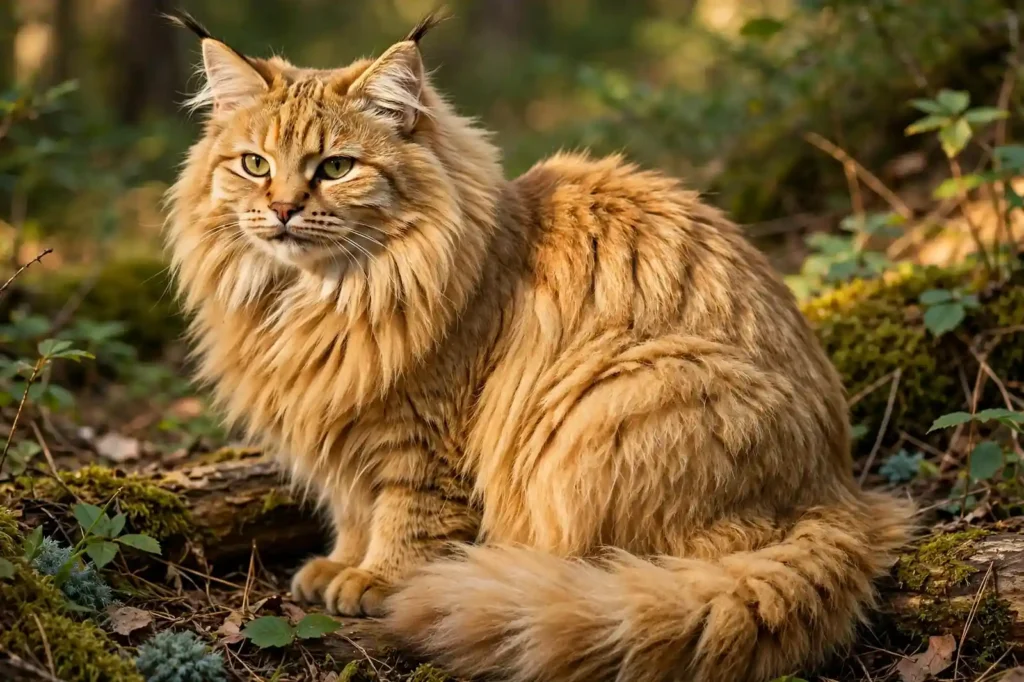
The Norwegian Forest cat is a large, heavy-boned yet elegant cat. According to the CFA, mature males weigh 12 to 16 pounds and females weigh 9 to 12 pounds, though some cats grow larger. The body is long and muscular, with strong legs and a long, bushy tail that the cat carries high. The head is triangular, with a straight profile, large ears set wide apart, and tufts of fur between the toes.
The coat is the breed’s defining feature. It is a double coat made up of a dense, woolly undercoat covered by long, glossy, water-repellent guard hairs. Around the neck the coat forms a full ruff, and the hind legs carry longer fur sometimes called “breeches.” The coat is heaviest in winter and sheds in spring, when the thick undercoat comes out and the cat looks noticeably slimmer.
The breed grows slowly. According to the CFA, it can take up to five years for a Norwegian Forest cat to reach its full size, which is longer than most breeds. A young cat may look nearly grown at two years old and still be filling out in its fourth or fifth year.
Compared with the tall Maine Coon, the Norwegian Forest cat is a little smaller and more compact, though both are large longhaired breeds with plumed tails. Compared with the short-coated British Shorthair, it looks longer and more elegant, and compared with the Persian, its coat is less profuse and its face less flat.
Personality: Calm, Friendly, and Independent
The Norwegian Forest cat is calm, friendly, patient, and adaptable. It enjoys company without demanding it every minute, and it is happy to sit nearby while its owners go about their day. That balance makes it a good fit for many kinds of homes, from busy family households to quieter homes with one or two people.
Affection in a Norwegian Forest cat is steady rather than showy. It likes a lap, a spot on the sofa, and a greeting at the door, but it does not usually follow its owners from room to room. It is content to be near people and comes over for company when it wants it.
The breed is also known for being good with children. Norwegian Forest cats are patient and tolerant, and they take the noise and movement of a family home in their stride. They adapt well to visitors, new routines, and changes in the household.
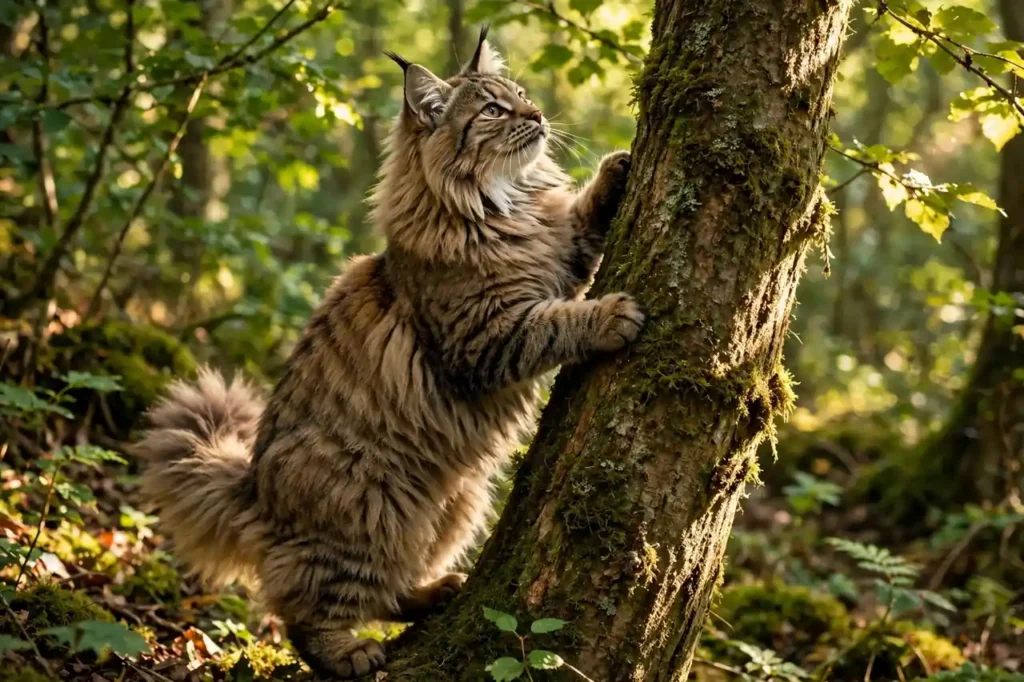
Play is part of a Norwegian Forest cat’s day, and climbing is its favourite kind. These cats are strong climbers by nature, and they love high places — a tall cat tree, a shelf, or the top of a wardrobe. A rolling ball, a toy mouse, or a feather wand will hold its interest, and it enjoys a game in the evening as much as a quiet nap in a sunny spot. Compared with a very talkative breed like the Siamese, it is quiet, and compared with the famously cuddly Ragdoll, it is a little more independent.
Norwegian Forest Kittens: Fluffy, Curious, and Slow to Grow
Norwegian Forest kittens are fluffy little cats from the start. They are born with soft, semi-long coats, and their round faces and large eyes give them a sweet, open look. Their markings — especially the tabby patterns — often show clearly from an early age, and the amber colour, when present, develops slowly over the first two years.
Kittens are curious and playful. They explore the house, chase toys, and investigate anything new, and they enjoy batting a ball, pouncing on a toy mouse, or chasing a feather wand. Climbing starts early too, and a kitten will soon be testing the highest perch it can reach.
Norwegian Forest kittens bond readily with the people around them. A kitten that grows up with gentle handling, regular play, and company becomes a confident, easygoing adult. Because the breed grows so slowly, a kitten keeps its playful manner for longer than most breeds — see our guide to the best cat breeds for first-time owners for comparisons.

Grooming and Everyday Care
Grooming a Norwegian Forest cat is simple and ordinary, though the long coat needs regular attention. A gentle brush once or twice a week removes loose hair and keeps the coat looking neat, and a soft brush or a wide-toothed comb works well. During the spring shed, when the thick undercoat comes out, brushing more often helps keep loose fur under control.
Beyond the coat, everyday care is straightforward. The ears can be checked and gently wiped as part of the regular grooming routine, and the claws can be trimmed as part of ordinary care.
Norwegian Forest Cat vs Other Popular Breeds: A Quick Comparison
Here is how the Norwegian Forest cat compares with other reader favourites:
| Trait | Norwegian Forest Cat | Maine Coon | British Shorthair | Russian Blue |
|---|---|---|---|---|
| Coat | Semi-long double coat, water-repellent | Long, shaggy double coat | Short, dense, plush | Dense double coat, silver-blue |
| Colours | Almost all, plus unique amber | Many colours and patterns | Mainly solid colours | Silver-blue |
| Build | Large, muscular, triangular head | Very large, rectangular body | Medium to large, stocky | Medium, lithe, fine-boned |
| Eye colour | Green, gold, copper | Green, gold, copper | Copper or gold | Vivid green |
| Energy | Moderate, loves climbing | Moderate, playful | Low to moderate | Moderate |
| Personality | Calm, friendly, independent | Friendly, gentle, social | Calm, quiet, independent | Quiet, devoted |
| Best for | Families wanting a calm, hardy companion | Families wanting a gentle giant | Quiet homes, calm companionship | Calm homes, devoted companionship |
The Maine Coon is the closest match in size and coat, but the Norwegian Forest cat is a little smaller and carries the unique amber colour. The British Shorthair is stockier with a short coat, while the Russian Blue is quieter and comes in a single silver-blue shade.
Interesting Facts About Norwegian Forest Cats
- A thousand-year history: Cats arrived in Norway with the Vikings around the year 1000, and the breed developed as a working farm and forest cat.
- The skogkatt: In Norway the breed is called the skogkatt, meaning “forest cat,” and fans often call it the “Wegie.”
- Nearly lost: Crossbreeding with shorthaired cats nearly wiped out the breed’s distinct type by the 1940s, until Norwegian breeders launched a preservation effort.
- A slow rescue: The first breed club was founded in Norway in the mid-1970s, and FIFe recognized the breed in 1977.
- First pair to America: The first breeding pair went to the United States in 1979, and the CFA granted championship status in 1993.
- The amber coat: A 2009 genetic study showed the amber colour comes from a single recessive gene change, and it is found in no other breed.
- Slow to grow: It can take up to five years for a Norwegian Forest cat to reach its full size.
Living With a Norwegian Forest Cat: What to Know
The Norwegian Forest cat is a cat for people who want a calm, steady companion with a wild, beautiful look. It will greet you at the door, sit beside you in the evening, climb to the highest perch in the house, and settle down for a nap in a sunny spot.
Compare the Norwegian Forest cat with other breeds in our most popular cat breeds guide, see how it suits new owners in our guide to the best cat breeds for first-time owners, and browse the Cats & Kittens section to keep exploring.
Related Reading on MyPetsMyLove
- Most popular cat breeds in the USA
- Maine Coon cats guide
- American Shorthair cats guide
- Cats & Kittens hub page
- MyPetsMyLove homepage
- About Us page
References
- The Cat Fanciers’ Association (CFA) — Norwegian Forest Cat breed standard and profile
- The International Cat Association (TICA) — Norwegian Forest Cat breed information and standard
- Encyclopaedia Britannica — cat breeds and history reference
Frequently Asked Questions
Where did the Norwegian Forest cat come from?
The Norwegian Forest cat comes from Norway, where cats arrived with the Vikings around the year 1000. The breed developed as a working farm and forest cat, shaped by cold winters and outdoor life. In Norway it is called the skogkatt, meaning “forest cat.”
What colours do Norwegian Forest cats come in?
Almost every colour and pattern found in cats, including solid colours, tabby, tortoiseshell, calico, and bi-colour patterns. Chocolate, lilac, cinnamon, fawn, and pointed patterns are not accepted. The amber coat, a honey-gold colour that develops over a kitten’s first two years, is found in no other breed.
How large do Norwegian Forest cats grow?
They are large cats. According to the CFA, mature males weigh about 12 to 16 pounds and females weigh about 9 to 12 pounds, though some cats grow larger. They also grow slowly and can take up to five years to reach full size.
Are Norwegian Forest cats good with children?
Yes, Norwegian Forest cats are known for being good with children. They are calm, patient, and adaptable, and they take the noise and movement of a family home in their stride. See our guide to the best cat breeds for first-time owners for comparisons.
What is a Norwegian Forest kitten like?
Norwegian Forest kittens are fluffy, curious, and playful, with soft semi-long coats and round faces. They love to climb from an early age and bond readily with the people around them. Because the breed grows slowly, kittens keep their playful manner for longer than most breeds.
How do you groom a Norwegian Forest cat?
Grooming is simple and ordinary. A gentle brush once or twice a week removes loose hair from the long double coat and keeps it looking neat. During the spring shed, when the thick undercoat comes out, brushing more often helps keep loose fur under control.
Why is the Norwegian Forest cat called Norway’s national cat?
The breed is widely described as Norway’s national cat because it developed naturally in Norway’s forests and farms over centuries. After nearly disappearing in the 1940s, it was rescued by Norwegian breeders, recognized by FIFe in 1977, and granted CFA championship status in 1993.
Conclusion
The Norwegian Forest cat began its story with the Vikings around the year 1000, worked on farms and in forests for centuries, nearly disappeared in the 1940s, and was rescued by dedicated breeders to become a recognized breed — FIFe in 1977 and CFA championship in 1993. With a thick, water-repellent double coat in almost every colour, including the amber found in no other breed, a large muscular build, and a calm, friendly, independent nature, it is a cat that fits happily into family life.
If you want a steady, hardy companion that enjoys company without demanding it every minute, the Norwegian Forest cat is hard to beat. Compare it with other remarkable breeds in our most popular cat breeds guide, explore the Cats & Kittens section, and start from the MyPetsMyLove homepage to meet more breeds worth knowing.
Disclaimer
Disclaimer
MyPetsMyLove dot com is an independent informational website covering pet species breeds characteristics activities positive training bonding grooming and responsible ownership
We are not a veterinary clinic medical provider pet food provider or veterinary nutrition service
We do not provide veterinary diagnosis medical advice treatment food recommendations or nutritional guidance
For pet health medical or food related concerns consult a qualified veterinarian or appropriate professional directly
Independent clinics listed on this website are not owned or operated by MyPetsMyLove unless explicitly stated
Verify third party credentials services fees and availability independently
We do not guarantee third party services or outcomes
To the extent permitted by applicable law we disclaim responsibility for independent third party services
Nothing in this notice excludes liability that cannot legally be excluded
The disclaimer does not make prohibited content acceptable