
French Bulldog: History, Appearance and Popularity

With its bat ears, squished-but-charming face, and compact muscular body, the French Bulldog is one of the most recognizable dogs on the planet. Playful, adaptable, and endlessly companionable, the “Frenchie” has gone from Parisian café mascot to the most popular dog breed in America.
How did a small bulldog from England become a French icon and then conquer the United States? This guide covers the French Bulldog’s surprising history, its distinctive appearance, its personality, and the story behind its remarkable rise to the top.
Origin and History of the French Bulldog
Despite the name, the French Bulldog started in England. In the mid-1800s, as the Industrial Revolution displaced cottage industries, English lace workers from Nottingham emigrated to France — and they brought their small toy bulldogs with them. These little dogs, bred down from larger bulldogs, were prized as companions and workshop ratters.
In France, the toy bulldogs crossed with local French dogs, and a distinctive new type emerged: smaller, with an even more compact build and those unmistakable upright ears. The breed became wildly fashionable in Paris, adored by café owners, artists, and fashionable society. The French gave it a name to match its new home: the Bouledogue Français.
The breed’s American chapter began when wealthy American tourists fell for the Parisian dogs and brought them home. At early American dog shows, a controversy erupted over the ears: English judges favored the traditional folded “rose” ear, while American breeders insisted the erect “bat” ear was the breed’s true signature. The Americans won the argument — the French Bull Dog Club of America, founded in 1897, wrote the breed standard specifying bat ears only. The American Kennel Club (AKC) recognized the French Bulldog in 1898, and the bat ear has defined the breed ever since.
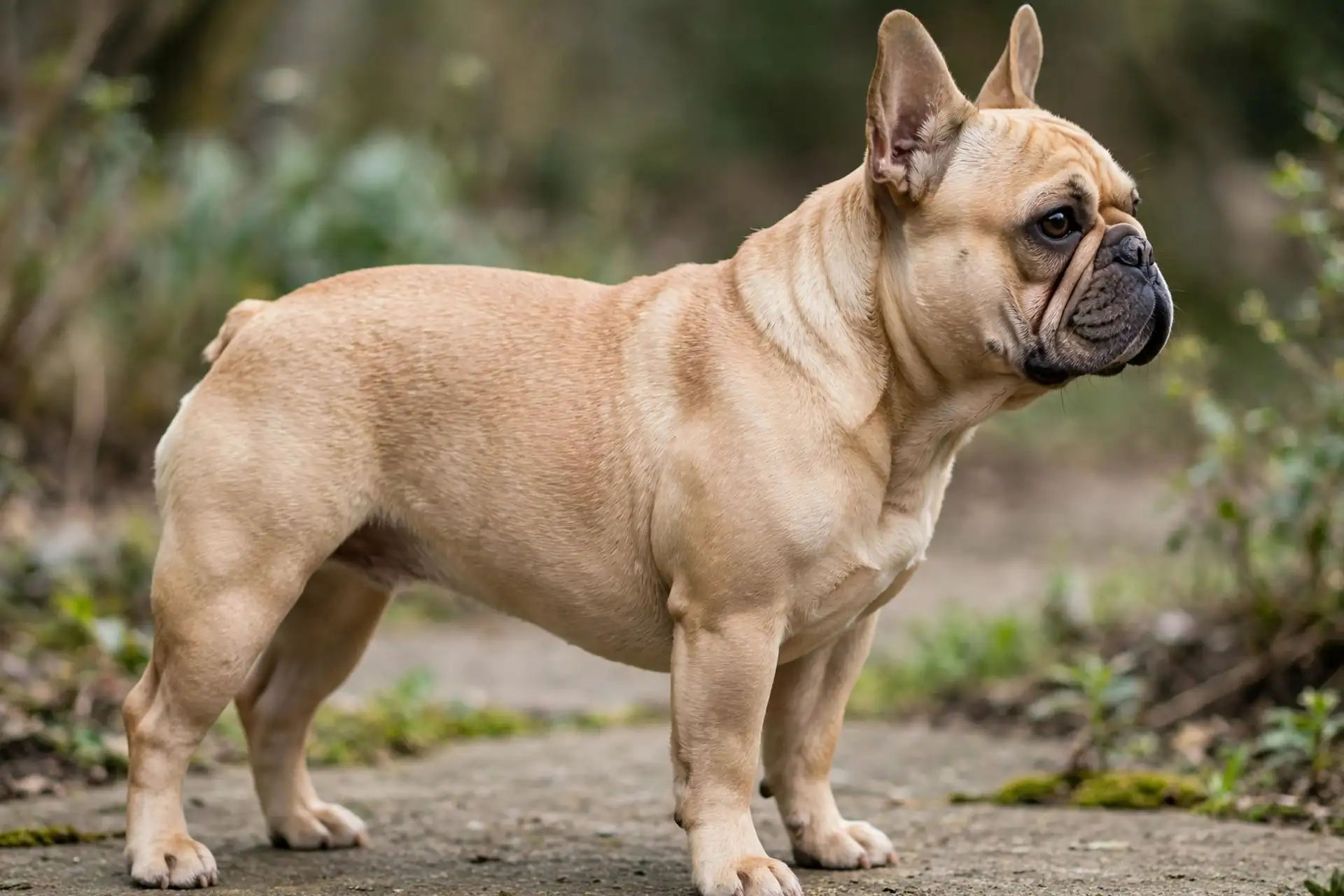
Appearance: Small, Muscular, and Unmistakable
The French Bulldog is a study in compact power. The AKC standard calls for a muscular, heavy-boned little dog, with weight not to exceed 28 pounds — most adults fall between 16 and 28 pounds, standing about 11 to 13 inches at the shoulder. Everything about the Frenchie is solid: broad chest, sturdy legs, and a short, stocky frame that feels heavier than it looks.
The head is the breed’s calling card. Large, square, and wrinkled, with a short muzzle, pronounced underjaw, and dark, expressive eyes set wide apart. And above it all, the ears: large, broad at the base, rounded at the top, and carried erect — the famous bat ears that early American fanciers fought to preserve. The tail is short, either straight or screwed, set low.

Coat Colors
The French Bulldog’s coat is short, smooth, and fine — easy to care for and soft to the touch. Common colors include:
- Brindle: dark stripes over a lighter base, one of the classic and most common patterns.
- Fawn: a warm tan ranging from light cream to deep reddish tan, sometimes with a black mask.
- Cream: a pale, even off-white shade.
- White: solid white, sometimes with patches of brindle or fawn.
- Pied: white with well-distributed patches of brindle or fawn.
Whatever the color, the short coat shows off the breed’s muscular definition and keeps grooming refreshingly simple.

Personality: The Clown in a Philosopher’s Coat
French Bulldog lovers describe the breed as playful, smart, and deeply affectionate — a companion dog through and through. Frenchies are famously adaptable: they are as happy in a city apartment as in a suburban house, needing only moderate exercise and a great deal of human company. Their even temperament and love of people make them natural family dogs, and they generally get along well with children and other pets.
There is a mischievous streak, too. Frenchies are known for their clownish antics, dramatic sighs, and an impressive range of snorts, snuffles, and grumbles that owners find endlessly entertaining. They are intelligent but famously strong-willed, which means training works best with patience, consistency, and positive methods — the same reward-based approach recommended for any breed.
Compared with high-drive working breeds like the German Shepherd, the French Bulldog asks far less in exercise and training intensity, which is part of its appeal for first-time owners. Our guide to the best dog breeds for first-time owners includes the Frenchie among breeds worth considering — with the honest caveat that its stubborn streak rewards owners who enjoy training as a partnership rather than a command performance.

Training a French Bulldog
Frenchies are smart enough to learn quickly and stubborn enough to test every rule. The combination responds best to short, upbeat training sessions built on praise, play, and affection — motivation here is about fun and togetherness. Keep sessions to five or ten minutes, end on a success, and stay consistent: every family member should enforce the same rules, because a Frenchie will happily exploit the softest household member.
House manners come naturally to the breed — Frenchies are clean, eager to please their people, and strongly motivated by togetherness. Leash manners and polite greetings are the highest-value skills to teach early, since an excited Frenchie greets the world at full volume and full speed.
French Bulldog Puppies: What to Expect
French Bulldog puppies are almost absurdly charming: roly-poly bodies, oversized bat ears that take a few weeks to stand fully erect, and enormous personalities from the start. They are playful and curious, and they bond to their people quickly and completely.
Puppies benefit enormously from early socialization — gentle exposure to different people, sounds, and environments — and from consistent, positive training begun right away. The breed’s stubborn reputation is really a consistency test: Frenchie puppies learn fast when training is fun and rewarding, and they remember every loophole when it is not.

Grooming and Everyday Care
The Frenchie’s short, smooth coat needs only occasional brushing to stay sleek and manage the moderate shedding. A soft bristle brush or grooming mitt once a week is plenty for most dogs.
The signature bat ears deserve regular attention: check them weekly and keep them clean as part of an ordinary grooming routine. The facial wrinkles should be kept clean and dry as well. Beyond that, the French Bulldog’s care is straightforward — quality companionship, short daily walks, interactive play, and a comfortable spot on the sofa, which the breed considers its rightful place.
The Rise to America’s Most Popular Dog
For 31 years, the Labrador Retriever held the AKC’s number-one spot as America’s most popular breed. Then, in 2022, the French Bulldog did what once seemed unthinkable: it took the crown — and it has held it in the AKC rankings every year since.
The rise makes sense when you look at how Americans live now. The Frenchie is tailor-made for modern life: small enough for apartments, moderate in exercise needs, low-maintenance in grooming, and overflowing with the affectionate, entertaining companionship people want most from a dog. Social media amplified the breed’s photogenic charm, and celebrity owners turned the Frenchie into a cultural icon.
The Golden Retriever and the rest of the perennial favorites in our most popular dog breeds guide remain beloved — but for now, the little bat-eared clown from Paris sits on the throne.
French Bulldog vs Other Popular Breeds
The Frenchie’s appeal is clearest in comparison. Here is how it stacks up against other perennial favorites from our most popular dog breeds guide:
| Trait | French Bulldog | Labrador Retriever | Golden Retriever | German Shepherd |
|---|---|---|---|---|
| Size | Small (16–28 lbs) | Large (55–80 lbs) | Large (55–75 lbs) | Large (50–90 lbs) |
| Exercise needs | Moderate | High | High | Very high |
| Apartment fit | Excellent | Challenging | Challenging | Poor |
| Grooming | Minimal | Moderate | High | High |
| Training style | Playful, needs consistency | Eager to please | Eager to please | Demanding, needs experience |
The takeaway: the Frenchie trades the athleticism and trainability of the big working and sporting breeds for unmatched adaptability to smaller spaces and busier schedules. For apartment dwellers and owners wanting a lower-maintenance companion, that trade is exactly the point.
Interesting Facts About French Bulldogs
- English roots, French fame: The breed was developed from English toy bulldogs brought to France by Nottingham lace workers in the 1800s.
- The ear war: Early American breeders insisted on erect bat ears over the English-preferred rose ear — and their 1897 club standard settled the matter permanently.
- An early AKC breed: The AKC recognized the French Bulldog in 1898, making it one of the club’s long-established breeds.
- 31-year streak broken: In 2022 the Frenchie ended the Labrador Retriever’s 31-year run as America’s most popular breed, per AKC registration statistics.
- Bouledogue Français: The breed’s French name simply means “French Bulldog” — the “French” honors where the breed was refined, not where it began.
- A quiet athlete: Despite the clownish reputation, Frenchies are sturdy little dogs that enjoy play and short adventures — on their own affectionate terms.
Is a French Bulldog Right for You?
The Frenchie is an excellent match if you:
- Live in an apartment or smaller home.
- Want a companion-first dog rather than a jogging partner.
- Can give plenty of daily companionship — Frenchies dislike long stretches alone.
- Enjoy training with humor and patience rather than strict discipline.
- Prefer minimal grooming and moderate exercise needs.
Think twice if you need a long-distance running buddy, want a guard dog, or are away from home for very long hours. For the right household, though, few breeds fit modern life as naturally — which is exactly what the AKC rankings have been saying since 2022.
Living With a French Bulldog: What to Know
The French Bulldog offers a rare combination: the charm of a comedian, the devotion of a shadow, and the practicality of a small, adaptable companion. It asks for moderate exercise, simple grooming, and — above all — your company. In return, it gives years of entertainment and affection.
If the Frenchie’s adaptable, people-focused nature appeals to you, compare it with other companion breeds in our best dog breeds for first-time owners guide, browse the Dogs & Puppies section, and start from the MyPetsMyLove homepage to meet more remarkable breeds.
Related Reading on MyPetsMyLove
- Most popular dog breeds in America
- Best dog breeds for first-time owners
- Labrador Retriever guide
- Dogs & Puppies hub page
- MyPetsMyLove homepage
- About Us page
References
Frequently Asked Questions
Where did the French Bulldog originate?
The French Bulldog originated in England, where Nottingham lace workers bred small toy bulldogs. When the workers emigrated to France in the mid-1800s, they brought the dogs along; the breed was refined in France — especially Paris — into the Bouledogue Français we know today.
Why does the French Bulldog have bat ears?
The erect “bat” ears were championed by early American breeders, who preferred them over the folded “rose” ear favored in England. The French Bull Dog Club of America, founded in 1897, wrote the breed standard specifying bat ears, and the AKC recognized the breed in 1898.
Is the French Bulldog really the most popular dog in America?
Yes. According to AKC registration statistics, the French Bulldog became the most popular breed in the United States in 2022 — ending the Labrador Retriever’s 31-year run at number one — and has held the top spot in the rankings since.
Are French Bulldogs good for apartments?
Yes. French Bulldogs are among the most apartment-friendly breeds: they are small, need only moderate exercise, are relatively quiet indoors, and thrive on close human companionship.
Are French Bulldogs good for first-time owners?
They can be a good choice for committed first-time owners. Frenchies are affectionate, adaptable, and eager to be with their people, though their stubborn streak means training works best with patience, consistency, and positive methods.
How big do French Bulldogs get?
The AKC breed standard calls for a weight not to exceed 28 pounds. Most adult French Bulldogs weigh between 16 and 28 pounds and stand about 11 to 13 inches tall at the shoulder.
Conclusion
From Nottingham workshops to Parisian cafés to the top of the American Kennel Club rankings, the French Bulldog’s journey is one of the great success stories in the dog world. The bat ears, the clownish charm, and the deep devotion to its people explain why this little dog conquered so many hearts.
If you are looking for an adaptable, affectionate companion that fits modern life beautifully, the Frenchie deserves serious consideration. Compare it with other top breeds in our most popular dog breeds guide, explore the Dogs & Puppies section, and start from the MyPetsMyLove homepage to discover more breeds worth knowing.
Disclaimer
Disclaimer
MyPetsMyLove dot com is an independent informational website covering pet species breeds characteristics activities positive training bonding grooming and responsible ownership
We are not a veterinary clinic medical provider pet food provider or veterinary nutrition service
We do not provide veterinary diagnosis medical advice treatment food recommendations or nutritional guidance
For pet health medical or food related concerns consult a qualified veterinarian or appropriate professional directly
Independent clinics listed on this website are not owned or operated by MyPetsMyLove unless explicitly stated
Verify third party credentials services fees and availability independently
We do not guarantee third party services or outcomes
To the extent permitted by applicable law we disclaim responsibility for independent third party services
Nothing in this notice excludes liability that cannot legally be excluded
The disclaimer does not make prohibited content acceptable



4 Comments