
Border Collie: Origin, Intelligence and Unique Characteristics

Ask dog trainers to name the smartest dog breed in the world and most of them will give you the same answer: the Border Collie. This medium-sized black-and-white herding dog can learn new commands after only a handful of repetitions, solve problems on its own, and read its owner’s smallest signals — a glance, a whistle, a shift in posture. One famous Border Collie, Chaser, learned the names of more than 1,000 toys in a university study, a feat no other dog has matched.
Yet intelligence is only part of the story. The Border Collie was shaped by centuries of work on the hills of the Anglo-Scottish border, and everything about it — its stare, its crouch, its stamina, its focus — was built for herding sheep. This guide covers the Border Collie’s origin, its appearance, its famous intelligence, the herding instinct, and what life with one is really like.
Origin of the Border Collie
The Border Collie comes from the border country between England and Scotland, the rugged hill land where shepherds have kept sheep for centuries. The word “collie” probably comes from an old word for the black sheep of the region, and “border” simply marks where the breed was developed. The dogs of the border hills were working sheepdogs long before anyone wrote a breed standard for them.
The modern Border Collie traces back to a single dog named Old Hemp, born in 1893 in Northumberland. Old Hemp was a quiet, intelligent sheepdog whose herding style — calm, focused, and controlled — became the model for the breed. Almost every Border Collie alive today descends from him. The breed’s name was first used in print in 1915, when the secretary of the International Sheep Dog Society, James Reid, began calling the dogs Border Collies to separate them from other collie types.
For most of the breed’s history, working ability mattered more than looks. Shepherds bred for herding skill, intelligence, and stamina, not for a uniform coat or shape. That is why the Border Collie is still judged first as a working dog.
Appearance of the Border Collie
The Border Collie is a medium-sized dog, athletic and well balanced, built for speed and stamina rather than bulk. The body is slightly longer than it is tall, the chest is deep, and the legs are strong and straight. The breed moves with a smooth, ground-covering stride, and it can run and turn at speed without tiring.
The best-known coat is black and white, but the breed comes in many colours: red and white, blue merle, chocolate, tricolour, and sable, among others. Two coat types exist. The rough coat is medium-length with a thick mane and feathering on the legs and tail, while the smooth coat is short and sleek. Both types have a dense double coat that protects the dog in cold and wet weather.
The head is broad with a clear stop, the muzzle is tapered, and the ears are medium-sized, usually semi-pricked and carried forward. The eyes are oval, most often brown, and they carry the breed’s most famous feature — an intense, focused expression that handlers call “the eye”. The tail is long and low-set, with a slight upward curve at the end, and it hangs down when the dog is relaxed.

The Famous Intelligence
The Border Collie is widely regarded as the smartest dog breed, and the claim rests on more than reputation. In studies of canine intelligence, the Border Collie ranks first for working and obedience intelligence — the ability to learn new commands quickly and obey them reliably. Most Border Collies learn a new command after fewer than five repetitions, and they remember it.
The most celebrated example is Chaser, a Border Collie studied by researchers at Wofford College in the United States. Chaser learned the proper names of more than 1,000 toys and could pick out a named toy from a large pile, even when the toy was new to her. The study showed that a dog could learn words in a way once thought to belong only to humans.
This intelligence is practical, not just a party trick. A Border Collie watches its owner constantly, learns routines, and works out how to get what it wants. But the same cleverness means a bored Border Collie will find its own work — opening gates, herding children, or rearranging the garden.
The Herding Eye
The most distinctive trait of the Border Collie is “the eye” — an intense, fixed stare that the dog uses to control sheep. When a Border Collie works, it lowers its head, crouches low, and fixes its eyes on the sheep. The stare alone is often enough to make the flock move, and the dog can hold a whole group of sheep in place with nothing but its gaze.
The eye is part of a sequence of herding behaviours. The dog circles wide around the flock, creeps forward in a crouch, stares, and then moves in to push the sheep in the direction the shepherd wants. The crouch is so characteristic that it has a name in the sheepdog world — the dog is said to be “clapping” to the ground. A Border Collie can work a flock at a distance, responding to whistles and hand signals from a shepherd hundreds of yards away.
This instinct is so strong that it appears in puppies with no training at all. A young Border Collie will stalk and stare at anything that moves — other dogs, children, bicycles, even a rolling ball.

Temperament and Personality
The Border Collie is energetic, focused, and deeply loyal. It bonds closely with its owner and wants to be part of everything the owner does. The breed is sensitive and reads human moods well — it notices a change in tone, a frown, or a smile, and responds to it. Harsh handling does not suit this dog; it learns best from patient, consistent guidance.
With its family the Border Collie is affectionate and playful. With strangers it is usually polite but reserved, watching first before deciding whether to make friends. The breed is not naturally aggressive, but it is protective of its home and its people, and it will sound the alarm when something is unfamiliar.
The Border Collie’s energy is famous. This is a dog that was bred to work all day on rough hills, and it brings that stamina home. A Border Collie that gets a short walk and a pat on the head will still have energy to burn at the end of the day.
Training and Activities
Training a Border Collie is a pleasure and a responsibility. The breed learns fast, so it picks up good habits quickly — and bad habits just as fast. Short, varied training sessions work best, because a Border Collie gets bored with repetition. Positive training, with rewards for the right behaviour, brings out the best in this dog, and the breed excels at obedience, where its precision and focus shine.
Dog sports were almost made for the Border Collie. It dominates agility competitions, where its speed, turning ability, and willingness to work with a handler give it an edge. It also excels at flyball, herding trials, and canine freestyle. For owners without access to organised sports, a long game of fetch is a good substitute — and for ideas on choosing toys that stand up to an athletic dog, see our guide to the best dog toys.
Mental work matters as much as physical exercise. A Border Collie needs problems to solve: puzzle toys, scent games, learning new commands, and herding-style games all help. A dog that works its brain during the day settles happily in the evening.
Living With a Border Collie
Life with a Border Collie is active and rewarding, but it is not a casual commitment. The breed needs at least an hour of exercise a day, and more is better — long walks, runs, or play sessions, plus training and mental games. A house with a yard helps, but a yard alone is not enough; the dog needs its owner to work and play with it.
The Border Collie does well in a home with a routine. It likes to know when walks, rest, and training happen, and it settles best when the day has structure. It gets on well with children who are old enough to play respectfully, though its herding instinct may make it nip at the heels of running children — a behaviour that needs gentle, consistent guidance. It usually gets on with other dogs, especially when socialised early.
Grooming is straightforward. The coat needs a brush once or twice a week, more often during seasonal shedding, and the ears can be checked and gently wiped as part of the regular routine. The Border Collie sheds, and owners should expect dog hair on the furniture — a small price for the companionship.
A Border Collie that is worked, trained, and loved is a calm and contented dog at home. A Border Collie that is bored is a different animal altogether: restless, destructive, and unhappy.

Border Collie Puppies
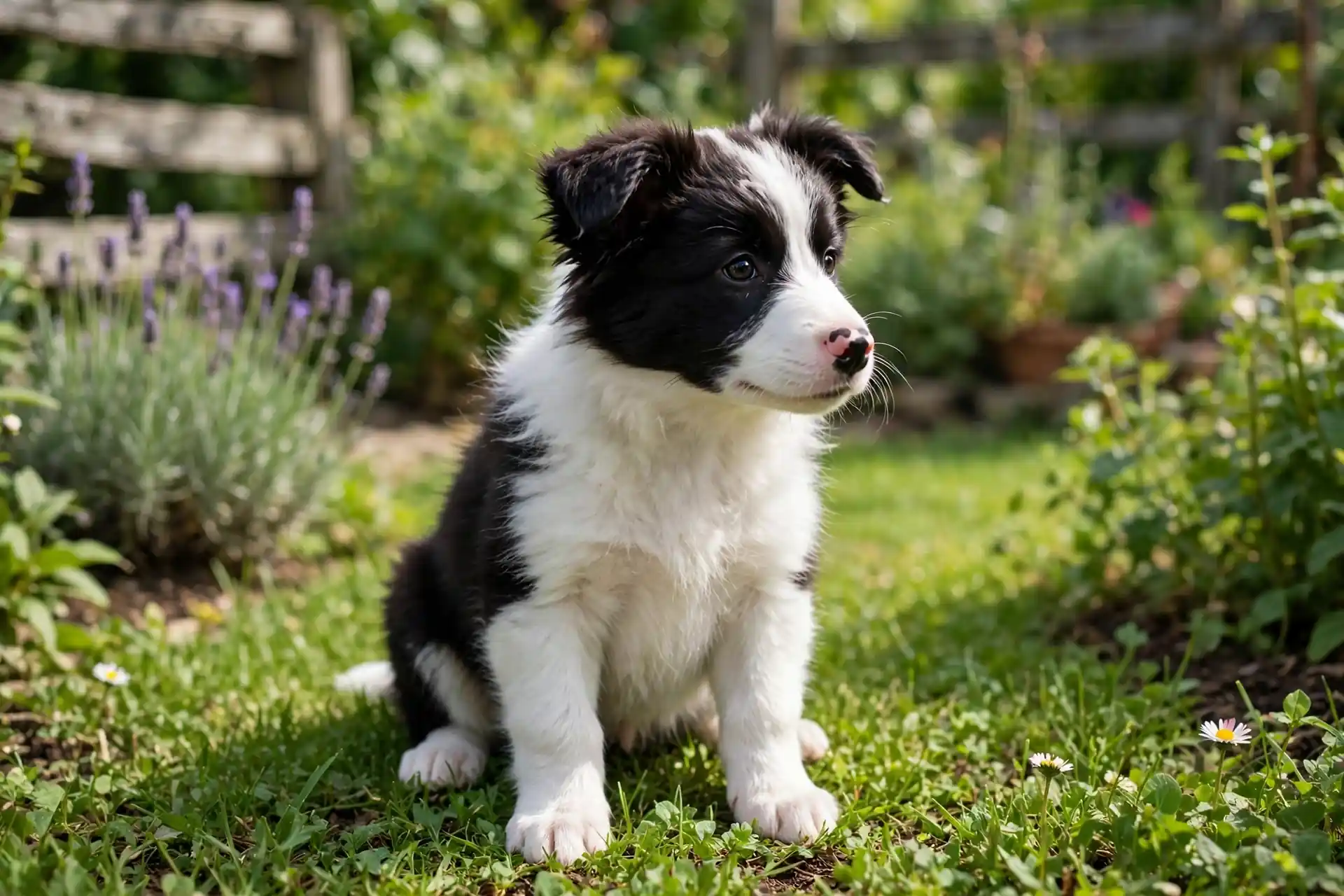
Border Collie puppies are quick learners from the start. They watch everything, follow their owners everywhere, and pick up household routines within days. Early socialisation matters: a puppy that meets different people, dogs, sounds, and places in its first weeks grows into a confident adult.
Puppies need short training sessions, plenty of play, and clear boundaries. The herding instinct appears early — a puppy may stalk and chase anything that moves — and gentle guidance from the start helps channel it. Readers comparing herding breeds can also look at our German Shepherd guide for another famous working dog.
Border Collie vs Other Intelligent Breeds
| Breed | Best known for | Energy level | Training style |
|---|---|---|---|
| Border Collie | Herding, intelligence, the eye | Very high | Fast learner, needs variety |
| German Shepherd | Guarding, police and service work | High | Loyal, precise, eager to work |
| Labrador Retriever | Retrieving, friendly nature | High | Enthusiastic, eager to please |
| Golden Retriever | Retrieving, gentle temperament | High | Patient, eager to please |
| Poodle | Intelligence, trainability | High | Quick learner, needs mental work |
The table shows the Border Collie’s place among the cleverest dogs. The Labrador Retriever, covered in our Labrador Retriever guide, is the friendliest of the group, while the Golden Retriever, covered in our Golden Retriever guide, is the gentlest. Among the most common dog breeds in America, the Border Collie is the one most often chosen by owners who want a true working partner, and readers can see how it compares in our guide to the most popular dog breeds in America.

Interesting Facts About Border Collies
- The smartest breed: The Border Collie ranks first for working and obedience intelligence in canine studies.
- A famous student: Chaser, a Border Collie studied at Wofford College, learned the names of more than 1,000 toys.
- One foundation dog: Almost every Border Collie today descends from Old Hemp, a sheepdog born in 1893.
- The eye: The breed’s intense stare can hold a flock of sheep in place with no sound at all.
- Born to herd: Puppies show herding behaviour — stalking, staring, and crouching — with no training.
- A dog of many colours: Black and white is the best-known coat, but the breed also comes in red, blue merle, chocolate, and tricolour.
- Sport champions: Border Collies dominate agility competitions around the world.
Related Reading on MyPetsMyLove
- Most popular dog breeds in America
- German Shepherd guide
- Corgi guide
- Dogs & Puppies hub page
- MyPetsMyLove homepage
- About Us page
References
- American Kennel Club (AKC) — Border Collie breed profile
- The Humane Society of the United States — pet care and enrichment resources
- Encyclopaedia Britannica — dog breeds and behaviour reference
Frequently Asked Questions
Where does the Border Collie come from?
The Border Collie comes from the border country between England and Scotland, where shepherds bred sheepdogs for herding on rough hill land. The modern breed traces back to a dog named Old Hemp, born in 1893.
Is the Border Collie really the smartest dog breed?
Yes, by the usual measure. The Border Collie ranks first for working and obedience intelligence — the ability to learn new commands quickly and obey them reliably. One Border Collie, Chaser, learned the names of more than 1,000 toys in a university study.
What is “the eye” in a Border Collie?
“The eye” is the breed’s intense, fixed stare, used to control sheep. The dog lowers its head, crouches, and fixes its eyes on the flock, and the stare alone is often enough to make the sheep move.
How much exercise does a Border Collie need?
A Border Collie needs at least an hour of exercise a day, and more is better — long walks, runs, or play sessions, plus training and mental games. The breed was made to work all day, so it needs both physical exercise and problems to solve.
Are Border Collies good with children?
They can be, especially with older children who play respectfully. The herding instinct may make a Border Collie nip at the heels of running children, so the behaviour needs gentle, consistent guidance from the start.
What colours do Border Collies come in?
Black and white is the best-known colour, but the breed also comes in red and white, blue merle, chocolate, tricolour, sable, and other combinations. Two coat types exist: rough (medium-length) and smooth (short).
Do Border Collies need a lot of training?
Yes. The breed learns fast and needs training every day to stay happy. Short, varied sessions with positive rewards work best, and the breed excels at obedience, agility, flyball, and herding trials.
Conclusion
The Border Collie is the smartest dog breed in the world, a tireless herding dog with an intense stare, a quick mind, and a loyal heart. From Old Hemp on the hills of Northumberland to Chaser’s thousand toys, the breed has shown what a dog can do when intelligence, focus, and partnership come together.
It is not an easy dog, but it is a rewarding one. Give a Border Collie work, training, and company, and it will give you loyalty, enthusiasm, and companionship without measure. Compare it with other great breeds in our most popular dog breeds in America guide, explore the Dogs & Puppies section, and start from the MyPetsMyLove homepage to meet more dogs worth knowing.
Disclaimer
Disclaimer
MyPetsMyLove dot com is an independent informational website covering pet species breeds characteristics activities positive training bonding grooming and responsible ownership
We are not a veterinary clinic medical provider pet food provider or veterinary nutrition service
We do not provide veterinary diagnosis medical advice treatment food recommendations or nutritional guidance
For pet health medical or food related concerns consult a qualified veterinarian or appropriate professional directly
Independent clinics listed on this website are not owned or operated by MyPetsMyLove unless explicitly stated
Verify third party credentials services fees and availability independently
We do not guarantee third party services or outcomes
To the extent permitted by applicable law we disclaim responsibility for independent third party services
Nothing in this notice excludes liability that cannot legally be excluded
The disclaimer does not make prohibited content acceptable

3 Comments