
Australian Shepherd: History, Coat Colours and Eye Patterns
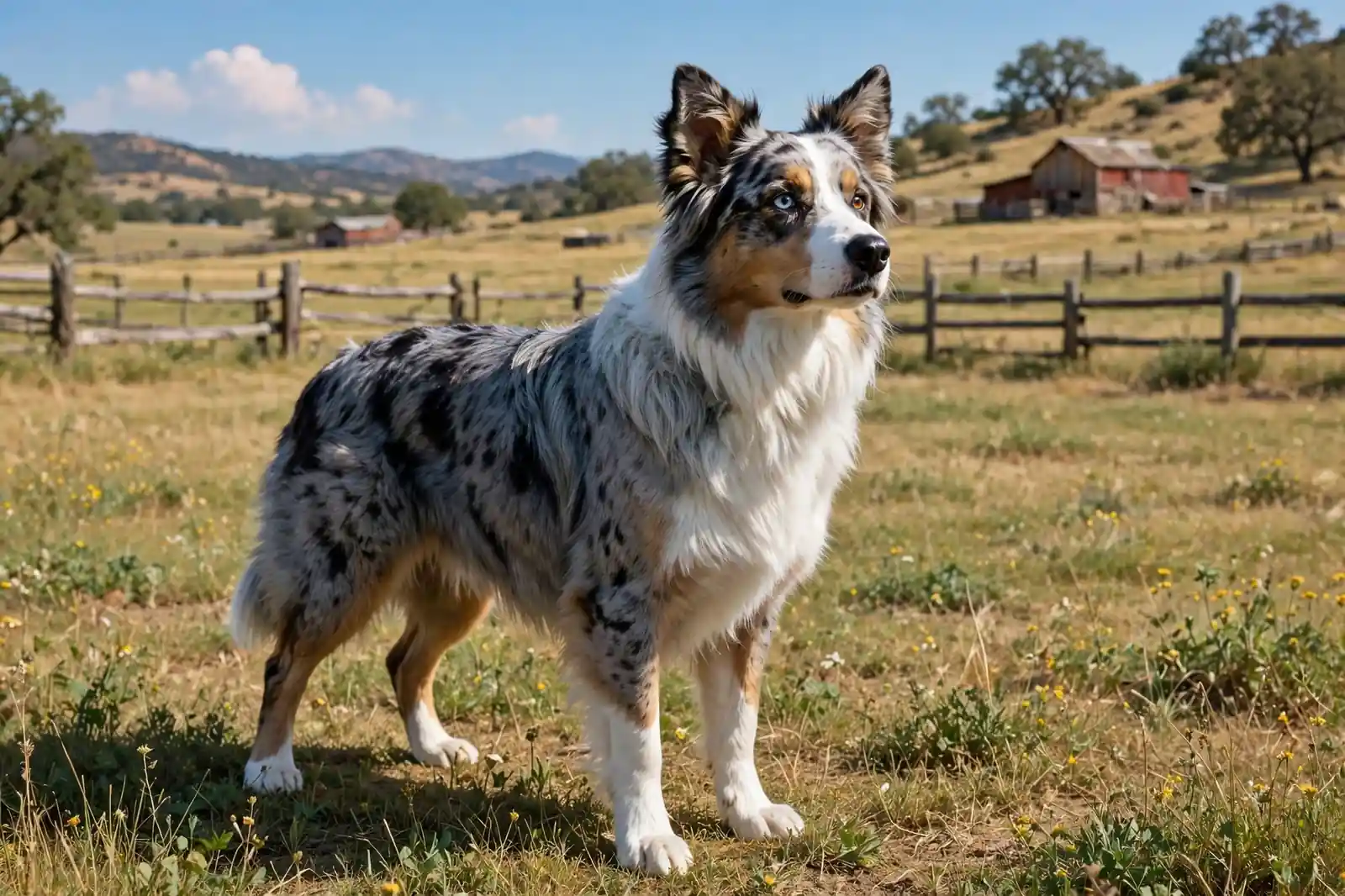
Here is a puzzle for dog lovers: the Australian Shepherd is one of the most American dogs ever bred. It was developed on ranches in the western United States, refined by cowboys and farmers, and named — somehow — for a country on the other side of the world. Add a coat that looks hand-painted in swirls of gray, red, black, and copper, eyes that can be blue, brown, amber, or two different colors in the same dog, and an energy level that outlasts almost everyone, and you have one of the most fascinating herding breeds in America. This guide covers the Australian Shepherd’s real history, its coat colors, its remarkable eyes, its temperament, and what life with an Aussie is really like.
A Name from Australia, a Breed from America
The Australian Shepherd’s history begins with the sheepdogs that traveled the world with Basque shepherds in the 1800s. Many of those shepherds reached the western United States by way of Australia, bringing their tough, talented herding dogs with them. American ranchers assumed the dogs were an Australian breed, and the name stuck — even though the dogs they admired were being shaped into a distinct breed on American soil.
Through the late 1800s and into the 1900s, ranchers in states such as California, Colorado, and Wyoming bred these dogs for the work in front of them: moving cattle and sheep across rough country, in heat, cold, and altitude. Herding skill, stamina, and intelligence mattered far more than a uniform look, so early Aussies varied in size and color.
The breed’s popularity grew after the Second World War, when Aussies became a familiar sight at rodeos, horse shows, and ranches across the West. A breed club was founded in 1957, and the Australian Shepherd later gained full recognition from the American Kennel Club in the early 1990s. Today it ranks among the most common dog breeds in the United States, known everywhere by its short nickname: the Aussie.
Herding Instinct and Intelligence
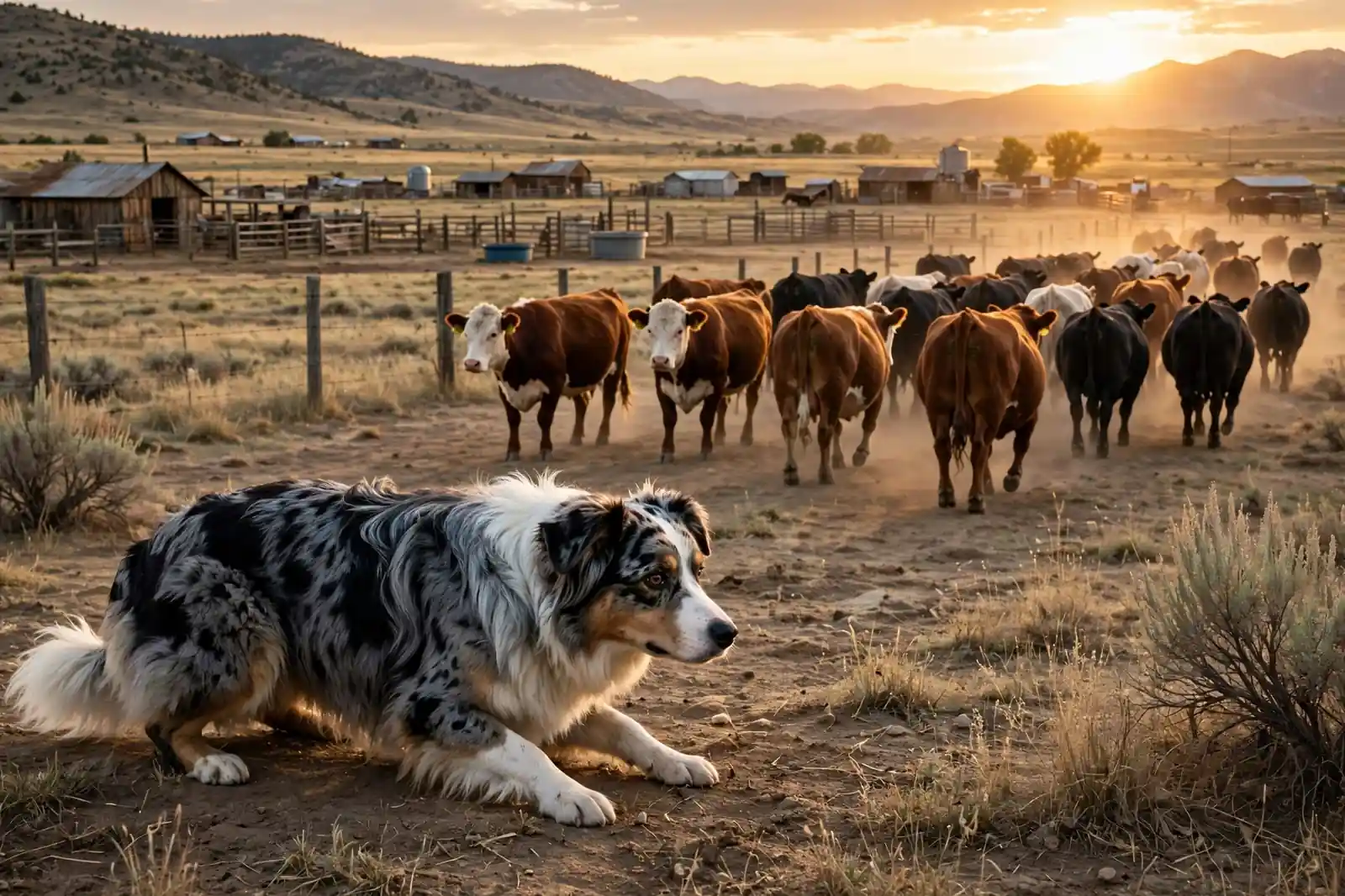
The Australian Shepherd was bred to think while it works. A ranch dog might be sent out across a pasture to gather scattered cattle, read the mood of the herd, and decide on its own how much pressure to apply. That history produced a dog that watches its owner closely, learns routines after only a few repetitions, and solves problems without being told how.
Handlers describe the breed’s herding style as versatile: an Aussie can work gently with sheep and turn firm and confident with stubborn cattle. The dog works with a loose, upright posture quite different from the low crouch of the Border Collie, and it uses its body, its movement, and a direct gaze to move stock.
That intelligence is a joy and a challenge at home. An Aussie learns household routines quickly, notices every change, and expects a job. Without work to do, this clever dog will invent its own — herding children, guarding the yard from the mail carrier, or rearranging the contents of a room.
Coat Colors: Black, Red, Blue Merle, and Red Merle
Few breeds wear as many colors as the Australian Shepherd. The breed standard recognizes four base colors: black, red, blue merle, and red merle. On top of those, white markings and copper or tan points can appear in many combinations, which is why two Aussies from the same litter can look strikingly different.
Merle is the pattern that turns heads. A blue merle Aussie has a mottled coat of black patches swirled over gray, while a red merle carries patches of red and liver over a lighter, silvery-red background. No two merle coats are alike; the pattern falls differently on every dog, making each one easy to recognize across a field.
The coat itself is medium in length, straight to slightly wavy, with a denser undercoat that suits outdoor work in changing weather. There is a moderate mane around the neck, fuller in males, and feathering on the backs of the legs. Regular brushing once or twice a week keeps the coat in order, with extra attention during the heavier seasonal shedding periods.

Eye Patterns: Blue, Brown, Marbled, and Mismatched
If the coat is the Aussie’s artwork, the eyes are the signature. Australian Shepherds can have eyes of almost any color: piercing blue, warm brown, amber, hazel, or green. Even more striking, the two eyes do not have to match. Many Aussies have heterochromia, the term for eyes of two different colors — one blue and one brown is a classic combination that stops people on the street.
Merle dogs add another pattern: marbled eyes, where two colors swirl within a single iris, such as blue flecked with brown. Solid-color Aussies can also carry blue eyes, so eye color does not follow coat color in any simple way. Combined with the breed’s alert, attentive expression, the effect is unforgettable — an Aussie seems to look straight through you, in the friendliest possible way.
The tail completes the picture. Many Australian Shepherds are born with a naturally short, bobbed tail, while others are born with a full-length tail; tail length varies naturally within the breed. The ears are triangular and set high on the head, folding forward or to the side when the dog is alert.

Temperament and Personality
The Australian Shepherd is loyal, devoted, and closely bonded to its family. This is a dog that wants to be involved in everything: it follows its people from room to room, joins every outing, and settles closest to whoever it considers its person. With strangers, an Aussie is typically reserved at first, watching before it decides to make friends.
Energy is the breed’s defining trait at home. The Aussie was built to work long days outdoors, and it brings that stamina into family life. It is playful, good-humored, and usually excellent with children it grows up with, though its herding instinct can appear as a habit of circling or nudging during lively games — a behavior that responds well to early, consistent guidance.
Aussies are protective of their home and people and quick to announce visitors, yet they are rarely unfriendly once a guest is welcomed. What they are not is independent: an Aussie left alone for long hours with nothing to do is an unhappy dog, and the breed does best with people who are home often or who take the dog along.
Aussie Puppies
Australian Shepherd puppies are bright, busy, and endlessly curious. Their colors are visible early, though merle patterns can shift slightly as the coat grows, and eye color may continue to settle during the first weeks. A young Aussie’s ears, energy, and herding instinct all arrive ahead of schedule — puppies will stalk, circle, and chase games long before they understand what the movements are for.
Early socialization matters a great deal for this observant breed. A puppy that meets different people, dogs, places, and sounds in its first months grows into a steadier adult. Short, playful training sessions work best, because Aussie puppies learn quickly and bore just as quickly. Readers comparing herding breeds can also look at our German Shepherd guide for another famous American favorite with a working past.

Training and Activities
Training an Australian Shepherd is one of the breed’s great pleasures. Aussies learn new commands fast, remember them well, and work happily for praise, play, and the chance to do the next thing. Short, varied sessions keep the dog’s attention, and clear, consistent guidance helps channel its enthusiasm in the right direction.
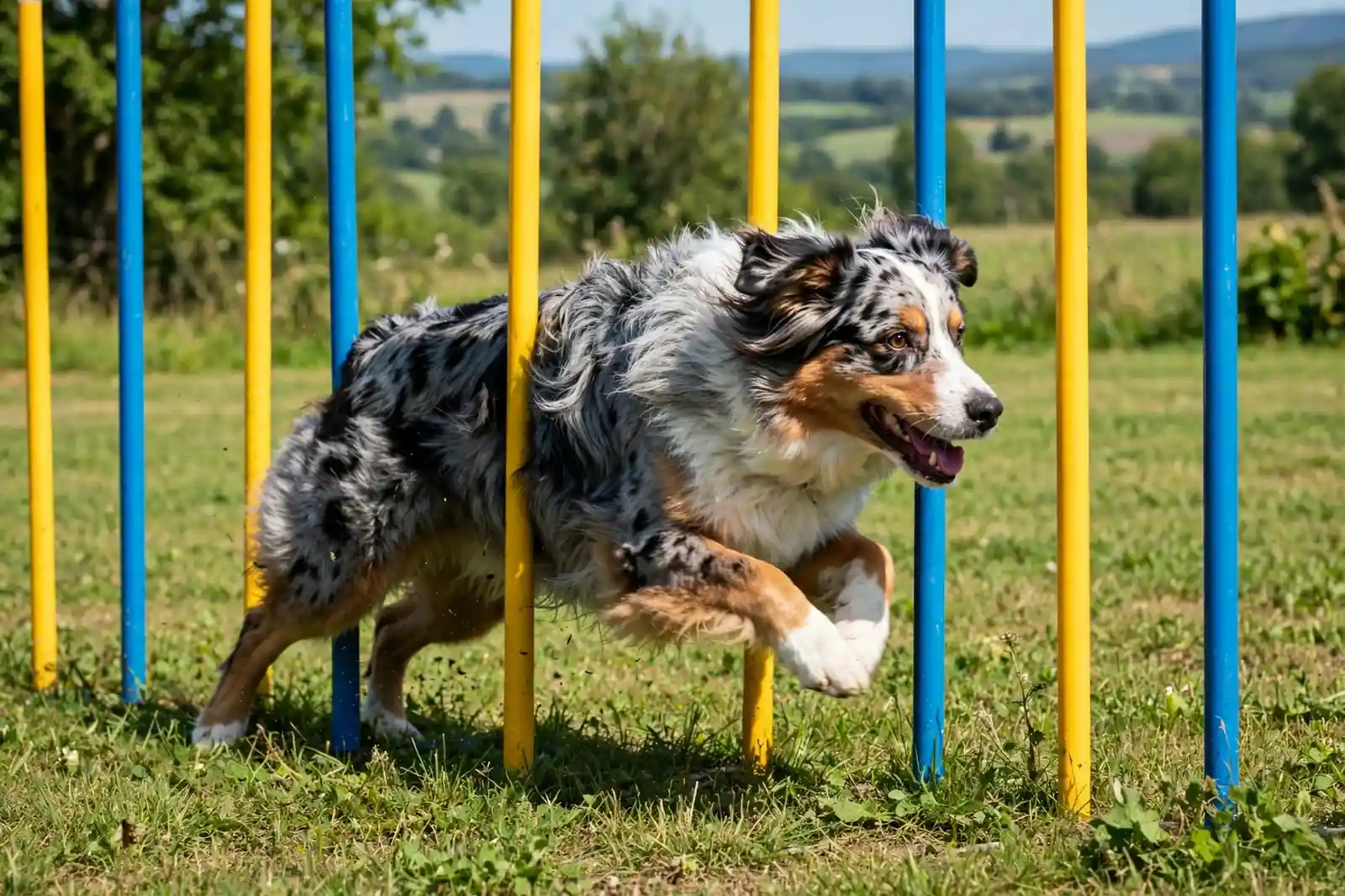
Dog sports suit the Aussie perfectly. The breed excels at agility, where its speed and turning ability shine, and at herding trials, flyball, disc games, and obedience. Hiking, running, and swimming are favorite everyday activities, and a long game of fetch with a durable toy goes a long way — our guide to the best dog toys covers sturdy options for athletic dogs.
Mental exercise matters as much as physical exercise. Puzzle toys, scent games, learning new tricks, and herding-style play all work the Aussie brain. A dog that has worked both its body and its mind during the day is calm, content, and ready to rest in the evening.
Living With an Australian Shepherd
Life with an Aussie is active, outdoorsy, and full of company. The breed needs a generous amount of daily exercise — long walks, runs, play sessions, and training time combined — and it is happiest with owners who enjoy being outside. A fenced yard is a real help, but a yard alone is not enough; this dog wants to do things with its people, not by itself.
Among popular US dog breeds, the Aussie asks more of its owners than most, and gives more back in enthusiasm and loyalty. It appears in our guide to the most popular dog breeds in America, where readers can compare it with other most best dog breeds for family life. Grooming is simple: a weekly brush, more during shedding, and a regular check of ears, coat, and nails as part of the routine.
An Australian Shepherd that is exercised, trained, and included in family life is a steady and joyful companion. The same dog without an outlet for its energy will find less welcome ways to spend the day, which is why honest self-assessment matters more with this breed than with almost any other.
Australian Shepherd vs Other Herding Breeds
| Breed | Origin | Coat highlights | Energy level | Best known for |
|---|---|---|---|---|
| Australian Shepherd | Western United States | Black, red, blue merle, red merle | Very high | Ranch work, merle coats, striking eyes |
| Border Collie | Anglo-Scottish border | Black and white most common | Very high | Herding stare, top-ranked intelligence |
| German Shepherd | Germany | Black and tan most common | High | Guarding, police and service work |
| Corgi | Wales | Red, sable, tricolor | Moderate to high | Short legs, royal following |
The table shows the Aussie’s place among herding favorites. The Border Collie is the specialist with the famous stare, the German Shepherd the versatile guardian, and the Corgi the compact herder with the long body. The Australian Shepherd is the all-purpose ranch hand of the group — colorful, keen-eyed, and ready for anything.
Interesting Facts About Australian Shepherds
- Not Australian: The breed was developed in the western United States; the name came from the dogs’ association with shepherds who arrived via Australia.
- A rodeo favorite: Aussies became famous across the American West through rodeos and horse shows after the Second World War.
- Every merle is unique: No two merle coats share the same pattern, so every merle Aussie is one of a kind.
- Two different eyes: Heterochromia — eyes of two different colors — is common and accepted in the breed.
- Natural bobtails: Many Aussies are born with a naturally short tail, a trait carried from their ranch-dog ancestors.
- A young breed on paper: Despite its long working history, the breed gained full American Kennel Club recognition only in the early 1990s.
- A short nickname: Owners almost never use the full name — around the world, the breed is simply the Aussie.
Related Reading on MyPetsMyLove
- Border Collie guide
- German Shepherd guide
- Most popular dog breeds in America
- Dogs & Puppies hub page
- MyPetsMyLove homepage
- About Us page
References
- American Kennel Club (AKC) — Australian Shepherd breed profile
- The Humane Society of the United States — pet care and enrichment resources
- Encyclopaedia Britannica — dog breeds and behaviour reference
Frequently Asked Questions
Is the Australian Shepherd really from Australia?
No. The breed was developed in the western United States by ranchers working with herding dogs that had arrived with shepherds traveling by way of Australia. American ranchers assumed the dogs were Australian, and the name stayed, even though the breed itself is American.
What colors do Australian Shepherds come in?
The breed comes in four base colors: black, red, blue merle, and red merle. White markings and copper or tan points can appear in many combinations, and merle patterns are unique to each dog, so Aussies vary a great deal in appearance.
Why do some Australian Shepherds have two different colored eyes?
The trait is called heterochromia, and it is common and accepted in the breed. One eye may be blue and the other brown, amber, or hazel. Some Aussies also have marbled eyes, where two colors swirl within a single iris.
Do Australian Shepherds have tails?
Many Aussies are born with a naturally short, bobbed tail, while others are born with a full-length tail. Tail length varies naturally within the breed, and both appear in litters from the breed’s ranch-dog history.
How much exercise does an Australian Shepherd need?
A lot. The Aussie was bred to work long days outdoors, so it needs generous daily exercise — long walks, runs, play sessions, and training — plus mental work such as puzzle games and learning new commands. An exercised Aussie settles calmly at home.
Are Australian Shepherds good with children?
They usually are, especially with children they grow up with. Aussies are playful and loyal, though the herding instinct can appear as circling or nudging during lively games. Early, consistent guidance helps channel that instinct.
Are Australian Shepherds easy to train?
Yes, they are among the quickest learners of all breeds. Aussies pick up new commands fast and enjoy working with their owners. Short, varied sessions with praise and play as rewards bring out the best in this intelligent dog.
Conclusion
The Australian Shepherd is an American ranch dog wearing an Australian name: intelligent, energetic, loyal, and dressed in some of the most striking colors and eye patterns in the dog world. Give an Aussie work, training, and company, and it will repay you with enthusiasm and devotion every single day.
Compare the Aussie with its herding cousins in our Border Collie guide and our roundup of the most popular dog breeds in America, explore the Dogs & Puppies section, and start from the MyPetsMyLove homepage to meet more dogs worth knowing.
Disclaimer
Disclaimer
MyPetsMyLove dot com is an independent informational website covering pet species breeds characteristics activities positive training bonding grooming and responsible ownership
We are not a veterinary clinic medical provider pet food provider or veterinary nutrition service
We do not provide veterinary diagnosis medical advice treatment food recommendations or nutritional guidance
For pet health medical or food related concerns consult a qualified veterinarian or appropriate professional directly
Independent clinics listed on this website are not owned or operated by MyPetsMyLove unless explicitly stated
Verify third party credentials services fees and availability independently
We do not guarantee third party services or outcomes
To the extent permitted by applicable law we disclaim responsibility for independent third party services
Nothing in this notice excludes liability that cannot legally be excluded
The disclaimer does not make prohibited content acceptable

One Comment