

Cat Puzzle Toys: How They Make Indoor Play More Interesting
Indoor cats live safe, comfortable lives — but comfort can quietly turn into boredom. Without the sights, sounds, and small hunts of the outdoors, many indoor cats spend long stretches of the day with little to do. That boredom can show up as restlessness, destructive scratching, or midnight zoomies. Play is the antidote, and cat puzzle toys are among the cleverest ways to make that play richer.

Unlike a simple ball or a crinkle mouse, cat puzzle toys ask something of your cat’s brain. They pair play with problem-solving: bat the right panel, nudge the sliding door, or work out how the pieces move, and the game continues. For owners seeking indoor cat play ideas beyond tossing a toy across the room, puzzle toys add the mental stimulation that turns a few minutes of batting into a genuinely engaging activity.
This guide explains how cat puzzle toys work, the main types of interactive cat toys available, how difficulty levels progress, what materials and construction details to check, and how to choose the right cat enrichment toys for your cat’s personality and home.
What Are Cat Puzzle Toys?
Cat puzzle toys are interactive toys designed so that play requires the cat to figure something out. Instead of simply chasing a moving object, the cat must manipulate the toy — pawing at sliding panels, flipping small lids, reaching into hidden compartments, or setting a rolling toy in motion in just the right way — to keep the game going.
This problem-solving element is what sets puzzle toys for cats apart from ordinary toys. Cats are natural hunters whose play follows a sequence — notice, stalk, chase, pounce, capture — and a good puzzle toy engages several steps at once, giving the brain a workout alongside the body. The Humane Society of the United States highlights enrichment, activities that let animals use natural behaviors, as a cornerstone of indoor cat care, and puzzle toys are a textbook example.
Mental stimulation matters as much as physical exercise. A cat that spends energy solving small challenges during the day is often calmer and less likely to invent its own entertainment from your curtains. Puzzle toys also shine as solo play: unlike wand toys, many keep a cat occupied while you work or step out.
Types of Cat Puzzle Toys
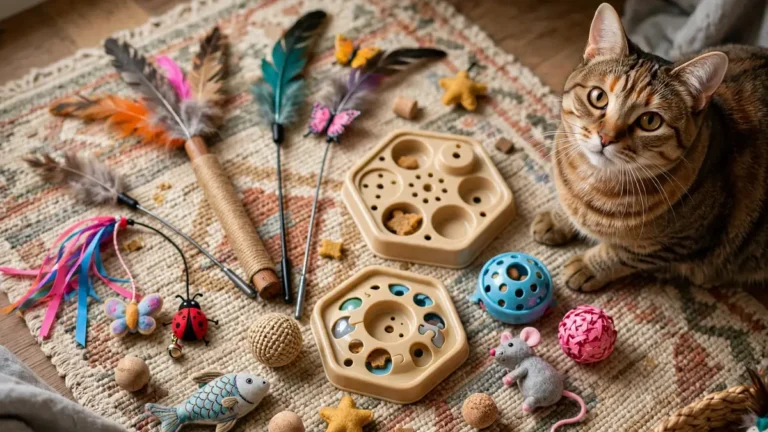
Cat enrichment toys come in a surprising variety of designs. Understanding the main types helps you match a toy to the way your cat likes to play.
Reward-Dispensing Puzzles
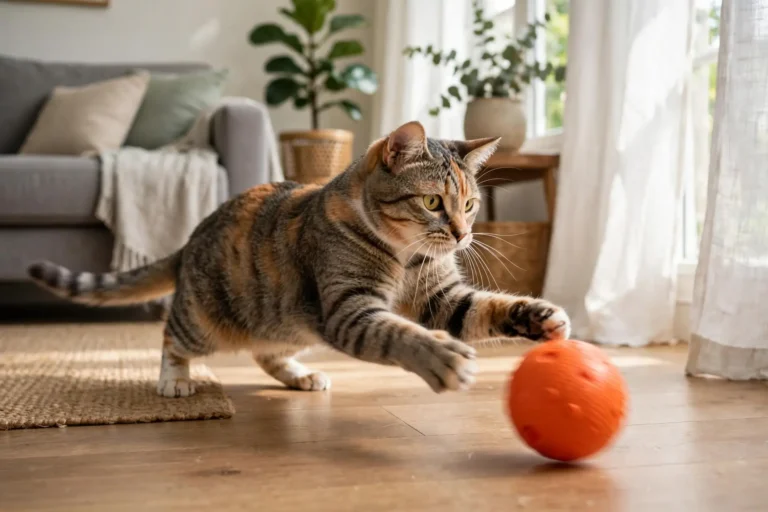
These are the simplest puzzle toys for cats: balls, eggs, or tumbler-shaped toys with openings that release small rewards as the cat bats, rolls, or nudges them. The cat quickly learns that movement makes things happen, turning an ordinary afternoon into a foraging game.

Because the mechanism is one-step, reward-dispensing puzzles suit beginners well. Look for adjustable openings so you can vary the challenge, and choose a size that rolls freely without getting stuck under furniture.
Sliding, Spinning, and Flip-Board Puzzles
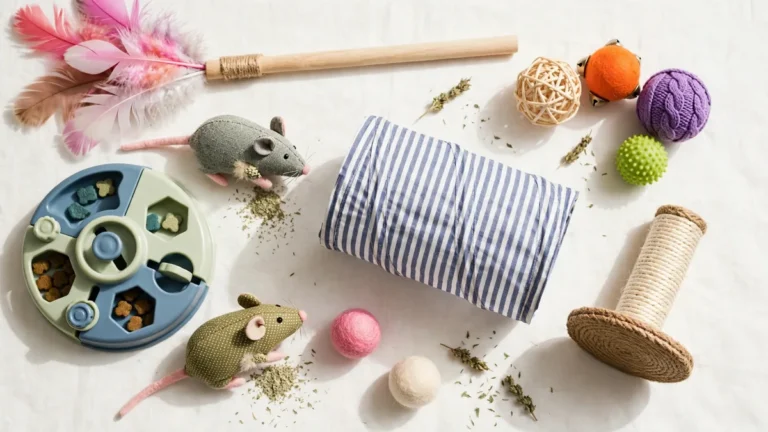
Flat puzzle boards take interactivity further: a board or box fitted with sliding panels, spinning discs, or flip-top lids, with small compartments underneath hiding tiny balls or toys. The cat must slide, spin, or lift each piece to reveal what is below.
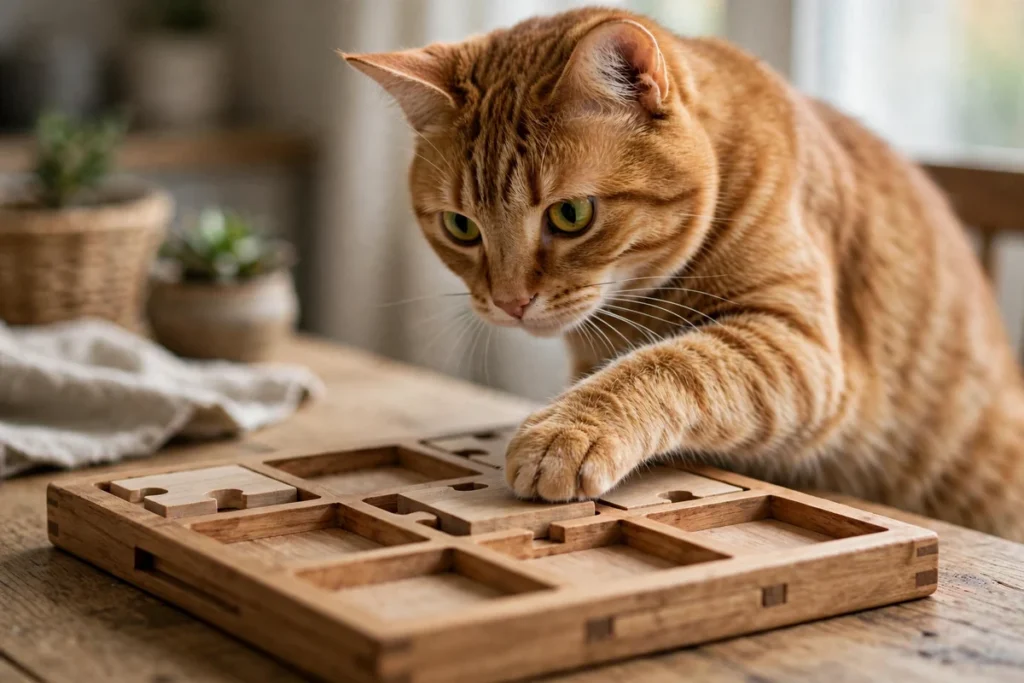
These puzzles reward paw dexterity and persistence. Many combine several mechanisms on one board, so the cat meets a new mini-challenge at every compartment — excellent for clever cats that master simple toys quickly.
Hidden-Compartment and Burrow Toys
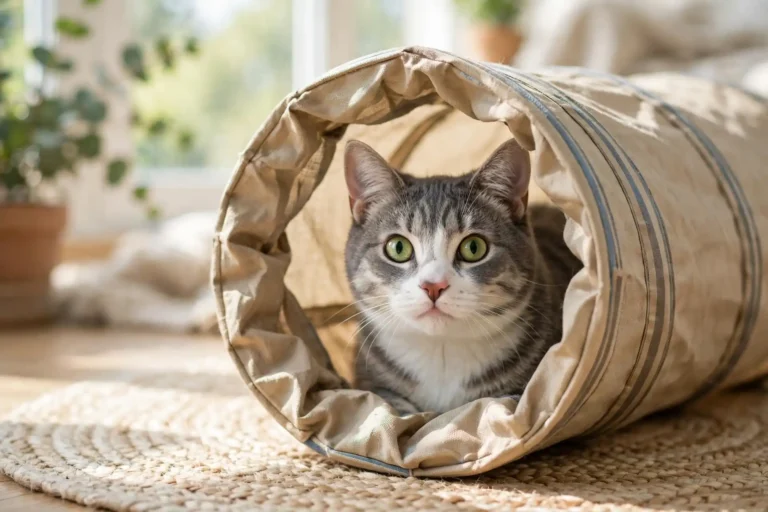
Some puzzle toys play on a cat’s love of peeking and pouncing from cover. Boxes with paw-sized holes, fabric burrows with hidden pockets, and pop-up designs let cats reach inside and fish out small toys tucked within — the cat can sense something inside but has to work to get it.
These suit cats that enjoy exploratory, nose-and-paw play. Cardboard designs are inexpensive and replaceable, while fabric versions often add crinkle textures for sensory interest.
Motion-Activated and Electronic Puzzles
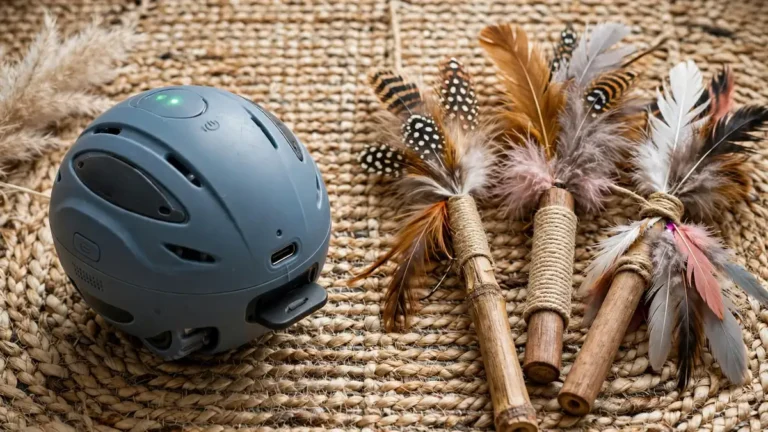
Electronic puzzle toys add unpredictability: motion sensors trigger spinning teasers or popping lures when the cat approaches, and timers switch the toy on and off in intervals. The surprise factor keeps many cats coming back.
The trade-off is complexity — electronic toys need batteries or charging, and some make noise timid cats dislike — so they work best as one part of a rotation.
Multi-Activity Play Stations
The most elaborate cat puzzle toys combine several play styles in one station — a scratching surface, a sliding puzzle, a dangling teaser, and a rolling ball track around the base. They suit multi-cat households or owners wanting a single, substantial enrichment centerpiece.
Puzzle Toy Difficulty Levels
Difficulty progression is one of the most useful ideas in choosing cat puzzle toys: a puzzle that is too easy gets boring, and one that is too hard gets abandoned. Most fall into three rough levels.
Beginner puzzles involve a single, obvious step: bat a ball, tip a tumbler, or paw through one large opening. Ideal for kittens, first-time puzzle users, and cautious cats that need quick wins — always start here.
Intermediate puzzles add a second step or a choice: slide one panel to reach another compartment, or pick which opening to investigate. They suit confident adult cats ready for a longer challenge.
Advanced puzzles combine multiple mechanisms on a single board, requiring the cat to work through a sequence. They are made for clever, persistent cats — but the goal is engagement, not frustration: if a cat walks away repeatedly, the puzzle is too hard for now.
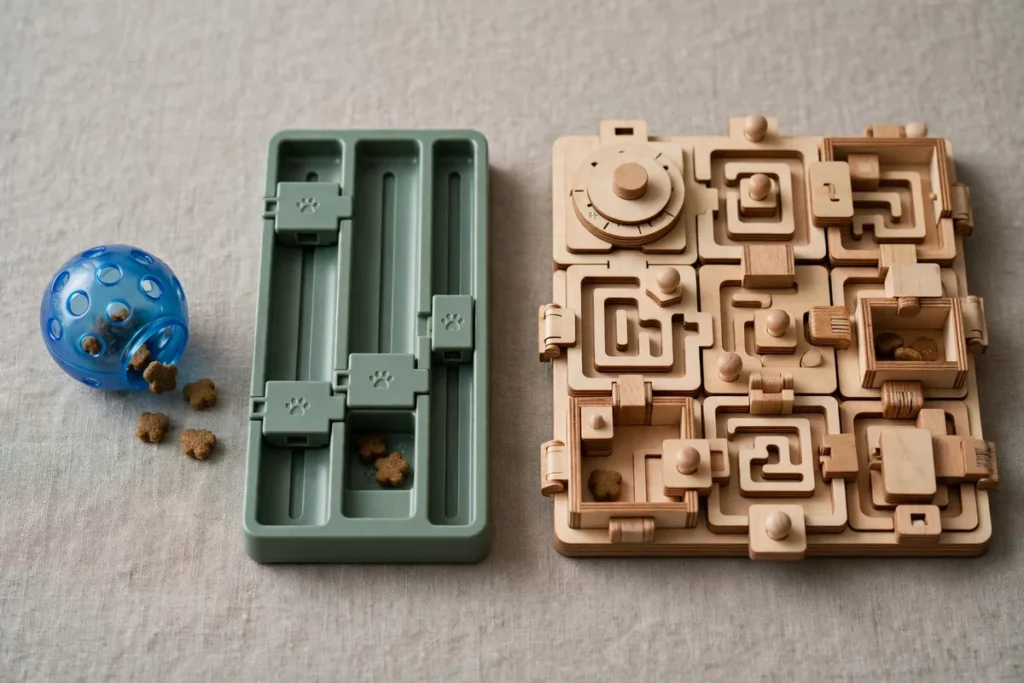
Progress gradually: move up only when current puzzles are solved quickly and confidently. An easy favorite can sit alongside a new challenge, so the cat always has both a sure win and something to work toward.
Materials and Build Quality: What to Look For
Puzzle toys take a beating — batted, bitten, and scratched — so construction quality matters more here than with most cat toys.
Plastic is the most common material: lightweight, easy to wipe clean, and able to hold precise moving parts. Check that edges are smooth, pieces fit snugly without pinch points, and small parts cannot be chewed off.
Wood gives puzzle boards a sturdy feel and stays put on smooth floors. Look for sanded, splinter-free surfaces and non-toxic finishes.
Cardboard appears in disposable-style puzzles and burrow toys. It is inexpensive and recyclable — great for testing whether your cat enjoys a puzzle style before investing in a sturdier version — and should be replaced once soggy or shredded.
Fabric shows up in burrow toys, pouches, and crinkle designs. Choose tightly woven fabrics with secure stitching and no loose threads or small detachable decorations.

Whatever the material, inspect puzzle toys regularly and retire anything with cracked plastic, splintered wood, frayed fabric, or loose small parts.
How to Choose the Right Puzzle Toy for Your Cat
With so many interactive cat toys available, the best choice depends on your individual cat.
Match the play style. Paw players love batting, sliding, and reaching, and thrive on sliding boards and ball tracks. Mouth players prefer to grab and carry, and often favor burrow toys and reward-dispensing designs they can nudge and bite.
Consider age and ability. Kittens do best with simple, lightweight beginner puzzles. Adult cats can handle the full range. Senior cats often still enjoy puzzles — choose designs with large, easy-to-move parts.
Think about your space. A sprawling multi-station suits a house with room to spare; a compact puzzle board fits an apartment. On hard floors, add a mat under lightweight puzzles so they do not skate away mid-game.
Plan a rotation. Cats lose interest in toys that are always available. Keep two or three puzzle toys out and store the rest, swapping every week or two — a “new” old toy feels fresh again after a break.
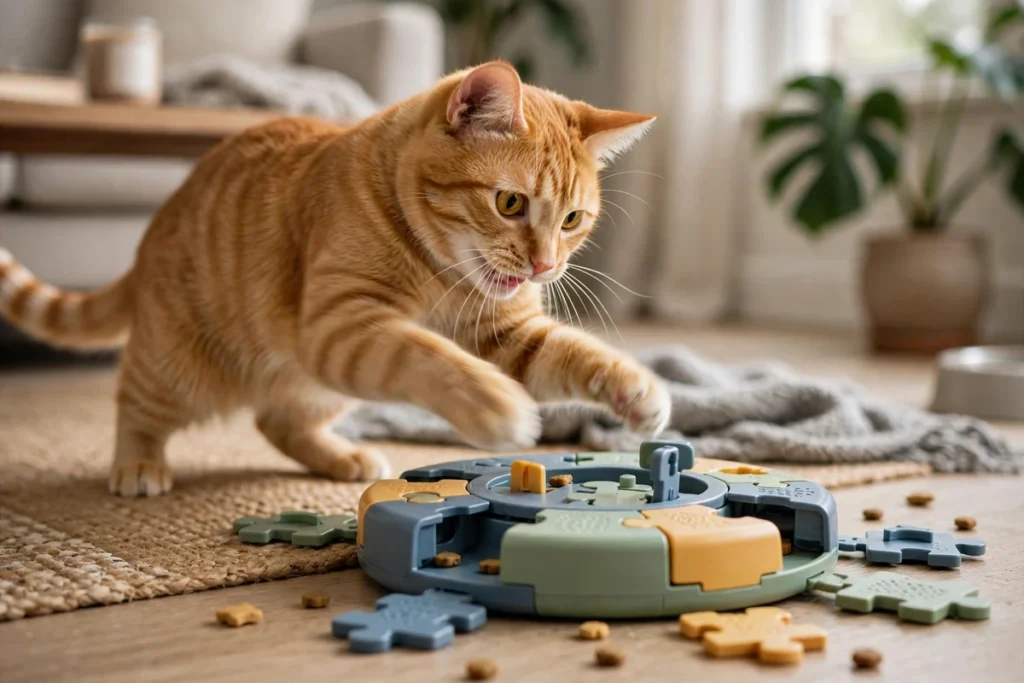
For more ideas on building a well-rounded toy collection, explore our Pet Products guides, where we compare everything from wand toys to automatic playthings.
Introducing a Puzzle Toy: Tips for Success
A little setup helps a new puzzle toy land well. Demonstrate first: move the sliders or roll the ball yourself while your cat watches — many cats learn faster by observation. Keep first sessions short and upbeat, and let the cat walk away whenever it wants.
Supervise early sessions until you are confident the cat uses the toy safely, and resist jumping straight to the hardest puzzle on the shelf. A few easy wins build the confidence that keeps indoor play interesting month after month.
Related Reading on MyPetsMyLove
- Best Wand Toys for Cats: Styles, Materials and Features
- Interactive Cat Toys: How to Choose the Right Playtime Accessories
- Best Cat Toys: 20 Types Every Cat Owner Should Know About
- Pet Products hub page
- MyPetsMyLove homepage
- Cats & Kittens hub page
References
- The Humane Society of the United States — cat enrichment and play resources
- American Association of Feline Practitioners (AAFP) — feline environmental needs guidelines
Frequently Asked Questions
What are cat puzzle toys?
Cat puzzle toys are interactive toys that require a cat to solve a small challenge — sliding a panel, flipping a lid, or working a mechanism — to keep playing. They combine physical play with mental stimulation, making them richer than toys that only move or make noise.
How do puzzle toys make indoor play more interesting?
They engage a cat’s problem-solving instincts alongside its hunting instincts. Instead of a few minutes of chasing followed by boredom, the cat gets an ongoing challenge: figure out the mechanism, get the payoff, and try the next compartment. That variety holds attention far longer than passive toys.
Are puzzle toys suitable for kittens and older cats?
Yes, with the right difficulty level. Kittens do well with simple, lightweight beginner puzzles, while older cats often enjoy puzzles with large, easy-to-move parts. Always supervise first sessions and choose designs sized appropriately for the cat.
How do I choose the right difficulty level for my cat?
Start with a beginner puzzle and watch how quickly your cat solves it. If it masters the toy within minutes and stays engaged, move up to intermediate. If the cat walks away or seems frustrated, step back down. Gradual progression keeps play rewarding instead of stressful.
How often should I rotate my cat’s puzzle toys?
Rotating every week or two works well for most cats. Keep two or three puzzles available and store the rest; bringing a stored toy back out makes it feel new again. Rotation prevents habituation and keeps indoor play interesting over the long term.
Are electronic puzzle toys better than manual ones?
Neither is universally better — they serve different purposes. Electronic and motion-activated puzzles add surprise for independent play, while manual boards and sliders give the cat full control and cost less. Many owners find a mix of both covers every mood.
Conclusion
Cat puzzle toys earn their place by doing what ordinary toys cannot: keeping a cat’s mind as busy as its paws. From simple reward-dispensing balls to multi-step puzzle boards, the right interactive cat toys turn idle indoor hours into engaging play — and a mentally stimulated cat is a happier, calmer companion.
Start simple, match the difficulty to your cat, rotate the collection, and watch which designs spark the most enthusiasm. For more indoor cat play ideas, browse our Pet Products guides and the MyPetsMyLove homepage.
Disclaimer
Disclaimer
MyPetsMyLove dot com is an independent informational website covering pet species breeds characteristics activities positive training bonding grooming and responsible ownership
We are not a veterinary clinic medical provider pet food provider or veterinary nutrition service
We do not provide veterinary diagnosis medical advice treatment food recommendations or nutritional guidance
For pet health medical or food related concerns consult a qualified veterinarian or appropriate professional directly
Independent clinics listed on this website are not owned or operated by MyPetsMyLove unless explicitly stated
Verify third party credentials services fees and availability independently
We do not guarantee third party services or outcomes
To the extent permitted by applicable law we disclaim responsibility for independent third party services
Nothing in this notice excludes liability that cannot legally be excluded
The disclaimer does not make prohibited content acceptable
3 Comments